
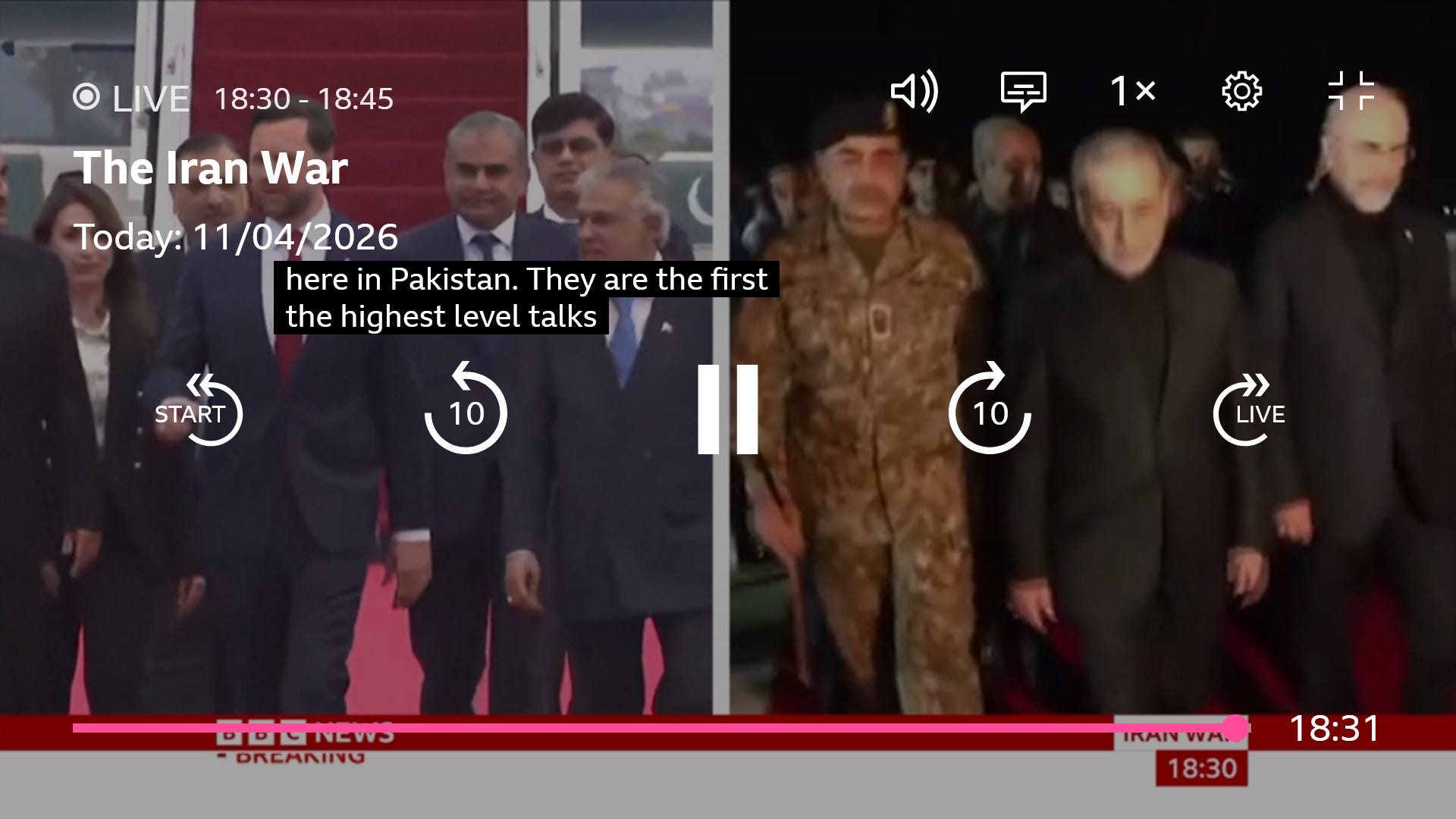
Direct high level talks between Iran and the US in presence of Pakistani mediators in the same room - for first time since 1979 - Four sessions - last one 1.30 - 3.30 am!

This is looking very promising so far, they wouldn’t be talking for so long unless they were far beyond just talks about talks.
[Skip to Contents]
The talks are going far far better than anyone expected in advance. Well at least anyone commenting publicly. They seem to have been more advanced privately than anyone realized in publicly shared information before the talks started.
There is no way that the two sides would have sent such large teams to preliminary talks about talks if that is what they expected.
This is going through the day roughly chronologically - I shared these updates as they happened on our forum here:
That’s set to fill the screen without distractions. If you want to, you can remove the ?cleanskipx to see the underlying forum.
Contents
You can get a good overview by reading the intro and then the section titles in the contents list.
I don’t do teaser titles, instead the titles are like mini abstracts. Unlike most blog posts my aim is to help scared readers to get the essence of what the blog post and the sections are about immediately, ideally wihtout even having to read them.
You can also click through to find out details.
Final session starts at 1.30 am, in person direct talks about points of disagreement
3:00 am Interview with Phil Stewart from Reuters and Vali Nasr, expert on Iran
Start of face to face talks - very unusual and sign of progress - first face to face talks for a long time and highest level talks since 1979
They are face to face in the same room with Pakistani mediators. This is very unusual and the BBC’s Lyse Doucet says “this is a sign of progress”
Iran normally refuses to sit in the same room with the Americans.
From Kasra Naji - BBC special correspondent from BBC Persian, he says it’s the first time they’ve sat together in front of each other since 2015.
It’s three way.
And the first time ever at this level, the VP of the USA talking to the Speaker of the Iranian Parliament.
It shows a change within Iran.
Ali Khamenei banned these direct talks. So there is a big change after his death.
He says the speaker has come with authority to speak about issues not necessarily in the documents they shared.
Glad to see the US team includes a large number of supporting experts.
QUOTE
A full suite of U.S. experts on relevant subject areas are present in Islamabad. Additional experts are supporting from Washington.
In context:
QUOTE STARTS
WH pool on Islamabad talks: Per a senior White House official, the U.S., Pakistan, and Iran are holding a trilateral face to face meeting today.
er U.S. official, delegation information is below.
Core U.S. Delegation:
JD Vance, Vice President of the United States
Steve Witkoff, U.S. Special Envoy for Peace Missions
Jared Kushner
Broader US Delegation:
Dr. Andrew Baker, Deputy National Security Advisor to the President and National Security Advisor to the Vice President
Michael Vance, Special Advisor to the Vice President for Asian Affairs
A full suite of U.S. experts on relevant subject areas are present in Islamabad. Additional experts are supporting from Washington.

Continued for 2 hours for first face to face talks before they broke for a rest
The talks between JD Vance, Witkoff and Trump’s son-in-law Kushner, and Iranian Parliamentary Speaker Qalibaf and Foreign Minister Araqchi lasted for 2 hours before the delegations broke for a rest, according to a Pakistani source. Pakistan’s army chief was also present

The talks then resumed after a break

BBC says that it is positive that technical experts are also involved. There has to be something to discuss that needs the attention of experts.
Lyse Doucet, BBC chief International correspondent, says they are the highest level talks since the 1979 Islamic Revolution in Iran.
US sends a couple of military ships into the Strait of Hormuz - preparatory to mine sweeping
This is a little incident that happened during the day. The US sent a couple of military ships into the Strait but not clear if they passed right through or turned back.
US Central Command CLAIMED that two miltiary ships passed through the Strait of Hormuz into the gulf of Oman. They want to clear mines and undersea drones there
QUOTE STARTS
US Central Command said on Saturday its forces have started setting conditions to clear sea mines in the Strait of Hormuz, with two Navy destroyers operating in the waterway as part of efforts to restore safe maritime transit.
CENTCOM said USS Frank E. Peterson and USS Michael Murphy transited the strait and operated in the Persian Gulf in a broader mission aimed at removing mines previously laid by Iran’s Islamic Revolutionary Guards Corps.
“Today, we began the process of establishing a new passage and we will share this safe pathway with the maritime industry soon to encourage the free flow of commerce,” said CENTCOM commander Gen. Brad Cooper.
The command added that additional US assets, including underwater drones, are expected to join the operation in the coming days.
https://www.iranintl.com/en/202604116946
(details of clearing undersea drones from BBC Persian correspondent on the BBC).
If it happend, i was only one transit but by two ships.
Also they are not equipped for mine sweeping so they must have just cleared the path that they sailed through in front of them as they went. Proper mine sweeping would involve dedicated ships going back and forth for several weeks or months.
But (if it happened) they did sail through the main strait instead of the route through iranian waters via Larak island.
I say “if” because the position a vessel broadcasts is based on a GPS signal they send when they have tracking switched on and that can be spoofed,
QUOTE
AIS spoofing is a form of AIS manipulation in which a vessel deliberately transmits false or misleading automatic identification system (AIS) data to conceal its true identity, location, or behavior. Rather than simply turning AIS off, spoofing allows vessels to appear compliant while masking illicit activity.
https://windward.ai/glossary/what-is-ais-spoofing/
The technical discussion of this on X said that it could be AIS spoofing by the US military to give the impression of going through the Strait when perhaps they didn’t really go all the way.
If they did do this, it is more of a symbolic guesture than effective mine sweeping.
I assume that though not designed as a mine clearing ship, a destroyer sailing slowly can detect mines in front of it using its mine-hunting active sonar, and sail around them (in a situation like this with very few mines) or perhaps given the very small number of mines, likely at most only one or two on any random path, detonate them by firing a torpedo at the mine or something. But it would be ridiculously ineffective to use as a mine sweeper.
There are probably only a dozen mines but they don’t know how many and it seems even Iran is not sure where they all are. So it could be a long operation to clear them effectively.
Second session of 2 hours with a working lunch
Iran and the US then talked for another two hours, including a working lunch and then exchanged documents.
Not much known about what they have decided if anything. This is normal for talks like this, it’s unusual to have much reporting at early stages as that makes the negotiations far easier to keep it confidential while they negotiate.
Pakistan says the main goal is to agree to continue talks.
Third session starting at 10 pm in Islamabad - leading to speculation that they must be serious negotiations
By then it was 10 pm in Islamabad and after a break they started a third session that continued beyond midnight in Pakistan.
It’s midnight in Islamabad and the US-Iran talks mediated by Pakistan are still underway at the Serena Hotel. Details are incredibly closely held — even we in the White House press corps don’t know if they will break and have a second day of talks or conclude this evening.
(Though technically I suppose we already are in “day 2,” since it’s officially Sunday here.)

Nothing revealed about what they have discussed - just ignore anyone who says they know what they have discussed so far.
But it’s reasonable to suppose that they have discussed
the Strait of Hormuz
a Hezbollah ceasefire
whether to continue talks.
Those are seen as the most urgent to sort out.
On that last surely the answer was yes to continue, they wouldn’t have such a long session and then say “we have decided not to continue talks”.
At least something involved technical experts too.
The experts all say this is very positive and more than they expected at this stage. Just talking face to face at all rather than in separate rooms was more than they expected.
New York Times says that the talks may be more advanced than previously disclosed.
Vali Nasr says such large Iranian team mean they are there with full authority to reach a deal with the US, not initial testing of the waters or stonewalling
It quotes an expert on Iran, Val Nasr, as saying that such a large team is what you need for a final deal not for initial talks about talks.
In Val Nasr’s own words:
QUOTE
I told @nytimes that the size and composition of Iran’s delegation shows “that they have not come to stonewall,” but are there with full authority and seriousness to reach a deal with the United States. Such a large delegation of experts would only be deployed if negotiations were in the final stages of a deal, not for an initial testing of the waters. Tehran and Washington might have advanced in talks further than publicly known during back-channel messaging mediated by Pakistan over the past weeks.”

QUOTE STARTS
Three senior Iranian officials familiar with the talks said Iran’s team had full authority to make decisions in Pakistan and was not required to consult with Tehran given the critical nature of the negotiations. The officials, who asked not to be named because they were discussing sensitive issues, said the new supreme leader Ayatollah Mojtaba Khamenei had given Mr. Ghalibaf, who is a close friend and ally, the power to make a deal or walk away.
…
Mr. Nasr, who also served in the State Department as a special U.S. representative to Afghanistan during the Obama administration, said that typically such a large delegation of experts would only be deployed if negotiations were in the final stages of a deal, not for an initial testing of the waters.
…
Mr. Nasr said that Tehran and Washington might have advanced in talks further than publicly known during back-channel messaging mediated by Pakistan over the past week.
https://www.nytimes.com/2026/04/11/world/middleeast/iran-delegation-pakistan-us.html
In context:
QUOTE STARTS
Iran appears to be taking the talks on Saturday seriously. The delegation of at least 70 people includes experienced diplomats and negotiators, experts in finance and sanctions, military officials and legal advisers, according to Iranian media and a list of the delegation seen by The New York Times.
…
Three senior Iranian officials familiar with the talks said Iran’s team had full authority to make decisions in Pakistan and was not required to consult with Tehran given the critical nature of the negotiations. The officials, who asked not to be named because they were discussing sensitive issues, said the new supreme leader Ayatollah Mojtaba Khamenei had given Mr. Ghalibaf, who is a close friend and ally, the power to make a deal or walk away.
…
Iran’s vice president, Mohammad Reza Aref, said in a social media post on Friday that Mr. Ghalibaf was now “representing the nation and the nezam,” using the Persian word for the Islamic Republic’s entire system, which includes not only the elected government but also the supreme leader. “I wish him success,” Mr. Aref said.“What we can read from Iran’s delegation is that they have not come to stonewall,” said Vali Nasr, a professor of Middle Eastern studies and an Iran expert at Johns Hopkins University. “They have come with full authority and seriousness to reach a deal with the United States.”
Mr. Nasr, who also served in the State Department as a special U.S. representative to Afghanistan during the Obama administration, said that typically such a large delegation of experts would only be deployed if negotiations were in the final stages of a deal, not for an initial testing of the waters.
…
Mr. Nasr said that Tehran and Washington might have advanced in talks further than publicly known during back-channel messaging mediated by Pakistan over the past week. Washington sent Tehran a 15-point peace plan and Iran replied with its own 10-point counter plan, which Mr. Trump said would be the framework for talks when he announced the cease-fire on Tuesday.Among the issues on the table are ending the war, opening the Strait of Hormuz to ships and Iran’s nuclear program. Iran’s interests include securing comprehensive sanctions relief, the release of frozen funds and compensation for damage during the war.
Iran has said that any peace deal, temporary or permanent, must also include its closest regional ally, Hezbollah, in Lebanon. This has been an especially fraught point of contention since massive Israeli airstrikes on Lebanon killed more than 300 people on Wednesday.
…
“The most important message Iran is sending with the composition of its delegation,” he said, “is that there is internal consensus for negotiations and a deal at the highest levels of the regime.”
https://www.nytimes.com/2026/04/11/world/middleeast/iran-delegation-pakistan-us.html
The aim may be to have details of a final peace agreement within two weeks (remarkably short period of time).
Sara Massoumi: agenda is to draft initial Memorandum of Understanding then start process to develop final peace agreement text in two weeks
This was retweeted by Lyse Doucet
QUOTE STARTS
Sara is Iran’s top diplomatic journalist
Translated from Persian
Islamabad Talks Agenda: From Drafting the Initial Memorandum of Understanding to Starting the Process of Developing the Final Peace Agreement TextDrafting the initial memorandum of understanding and finalizing the details of the final peace agreement within a two-week timeframe with the possibility of extension will be the desired outcome for both parties


Final session starts at 1.30 am, in person direct talks about points of disagreement
Another session started at 1.30 am in Islamabad. In person direct talks about points of disagreement.
QUOTE
And another session of talks, being dubbed as “final session” between US and Iran has begun in the presence of facilitators – These are in person, direct talks taking place amidst reported disagreements.
Still talking at just before 2 am according to the White House
This is looking very promising so far, they wouldn’t be talking for so long unless they were far beyond just talks about talks.
Still continues at 3 am with more planes from Iran to bring more negotiators, probably from the military means really could be some momentum here
Still going on at 3 am.
This section is based on an interview with Phil Stewart, chief national security reporter from Reuters, and Valir Nasr, former senior representative to Pakistan and now a professor of Middle East Studies at John Hopkins university.
[full transcript at the end]
Experts on the BBC say this suggests there really could be some momentum here.
More planes have come from Iran to join the deal bringing experts from the military. They already have the speaker of parliament, the foreign minister and many different elements of the Islamic government.
This has to be a really substantive effort by Iran - essentially they have sent everyone there that’s needed to make substantial decisions on the spot in Pakistan. Rather than back and forth for months of talks. They’ll be able to go back to Iran and present it as something that has wide support already from all those participating.
On the rumours of passage of ships or release of frozen funds - seems both sides are talking about trust building measures.
There could be serious working groups when they go home to work out the technical details - not Witkoff / Kushner.
That negotations go on this long must mean there is more flexibility than is said publicly.
And both very much want to get a deal over the line in some way. 0
The US is likely quite worried about ending the war with a toll like the Panama canal.
In return for the Strait of Hormuz, the US has to give up sanctions relief, and find a way for Iran to pay for its reconstruction - and then Iran has to give up its nuclear program.
Because neither of them want the war to start up again.
So that is the dynamic.
Witkoff and Kushner are very much sidelined. Vance has the authority. And this time he is supported by many technical experts which Witkoff and Kushner didn’t have.
The US is taking it far more seriously than ever before with a huge amount of technical support on site as well as back home.
More planes have come from Iran to join the deal bringing experts from the military. They already have the speaker of parliament, the foreign minister and many different elements of the Islamic government.
This has to be a really substantive effort by Iran - essentially they have sent everyone there that’s needed to make substantial decisions on the spot in Pakistan. Rather than back and forth for months of talks. They’ll be able to go back to Iran and present it as something that has wide support already from all those participating.
On the rumours of passage of ships or release of frozen funds - seems both sides are talking about trust building measures.
There could be serious working groups when they go home to work out the technical details - not Witkoff / Kushner.
That negotations go on this long must mean there is more flexibility than is said publicly.
And both very much want to get a deal over the line in some way. 0
The US is likely quite worried about ending the war with a toll like the Panama canal.
In return for the Strait of Hormuz, the US has to give up sanctions relief, and find a way for Iran to pay for its reconstruction - and then Iran has to give up its nuclear program.
Because neither of them want the war to start up again.
So that is the dynamic.And seems they are stuck in and must be getting somewhere, must have potential for progress to still be talking after 3 am.
And they HAVE to be showing flexibility or it couldn’t go on like this. Wouldn’t have 10 hours of the Iranians or the Americans saying no to any compromise.
Last session ends just before 3.24 am Pakistan time - then back to exchanging drafts with experts present
Last session ended at some time before 3.24 am Pakistan time. Then back to exchanging drafts with their experts present.
That’s promising that they are working on drafts.
TWEET Another round of trilateral talks between #Iran, the US, and Pakistan has concluded in Islamabad. Both sides are once again exchanging drafts with their expert teams present.


Will continue talks on the next day Sunday 12 April
And they will continue for another round tomorrow.
This is VERY promising that they have at least some points of agreement and something substantial to work from.
TWEET: Former Pakistani diplomat to the US Maleeha Lodhi says expectations from the Islamabad talks between the US and Iran should be realistic, stressing that “we should recognise that diplomacy is not an event, it’s a process, it takes time.”

The main accounts I’m following right now on these discussions are:
https://x.com/IranNuances
https://x.com/asmashirazi
https://x.com/SaraMassoumi
https://x.com/vali_nasr
https://x.com/CMShehbaz
https://x.com/lrozen
https://x.com/bbclysedoucet
3:00 am Interview with Phil Stewart from Reuters and Vali Nasr, expert on Iran
Interview with Phil Stewart, chief national security reporter from Reuters, and Valir Nasr, former senior representative to Pakistan and now a professor of Middle East Studies at John Hopkins university at 3 am
Let’s get some more analysis now on these talks uh which really are stretching on longer than I think many of us thought they would. With me here in studio, Phil Stewart, chief national security reporter for Reuters. And we also have Vali Nasr, a former senior adviser to the uh US special representative for Pakistan. He’s currently a professor of Middle East studies and international affairs at John Hopkins University.
Q. Vali, just to start with you, these talks still going on. What’s your reaction at least, you know, to the length of discussions that have been taking place?
Vali: I think it suggests that they are very substantive and they are getting into details and it reflects the fact that both sides came to Islamabad to arrive at a deal and it’s much more that a meet and greet session and and I think there is positive momentum if they haven’t gone back to their hotels or or intend to continue means that they are making gains and they are sticking with it.
Q. And Philip here in the studio. You know, we were just talking earlier and I think a bit of surprise maybe that that this first round here has has continued on into the night now 3:00 a.m. there in Pakistan.
Philip: Yeah, it’s shocking. You know, when you when you look at the public posturing by the US president and by the IRGC in Iran, you would think that these sides couldn’t be further apart, but the fact that they’re still speaking so late into the night until the early hours of the morning suggests there really could be some momentum here.
Q. You know, Vali, what more should we know about the actual delegation that Iran sent to these negotiations? We keep hearing from the president and the White House that most of the leadership regime there has been killed or is no longer in charge. We still haven’t seen the supreme leader in public. So, do we know, you know, who’s leading these negotiations and where do they stand on the key issues?
Vali: Well, the negotiations are being led by the speaker of Iran’s parliament, but he’s the direct representative of the supreme leader. He’s not there on his own and he has brought a very large delegation that includes not only people with technical knowledge like the director of the central bank or the foreign minister but even members of the parliament or people who are in the leadership who represent uh different political persuasions in Iran’s parliament which suggests that the entirety of Iranian system and particularly hardliners are part of these negotiations and are supporting it.
When we’re also hearing that there is a new delegation that has come from Iran as the talks have progressed which includes more of members of Iran’s military and security forces.
And if that’s true, it suggests that Iran has brought a delegation with the intent to get this deal done and a delegation that represents a political spectrum inside Iran so that it allows them to sell the deal back home.
So it it it shows intent to get to a deal.
Q. Phil, what about on the American side of things? It’s kind of that familiar duo. Jared Kushner, the president’s son-in-law. Steve Woodoff is kind of Swiss Army knife negotiator. U JD Vance, though, this time leading negotiations.
Vali: That’s right. And you know, if you take a step back, the last couple negotiations didn’t end so well, right? They ended with the US bombing of Iran, you know, back in July and then and then, you know, just just recently. So, if this if these negotiations end with anything other than the bombing of Iran and the resumption of a conflict, that would be a huge success. But it looks like the momentum again is moving towards some sort of understanding that potentially could allow for further negotiations.
I don’t think anyone’s expecting a final agreement necessarily today. But I think that there is obviously some work being made that could allow this conversation to continue.
Q. Vali, a lot of focus obviously on the straight of Hormuz and Iran’s control over it. There were reports of two US military ships passed through the strait earlier today. Iran denies that that happened. How significant would that be if that is actually true?
Vali: It is quite significant. I mean, there are these rumors that are going around the passage of these ships or whether or not the US is going to allow some of Iran’s frozen funds abroad to be released that suggest that both sides are trying to talk about trust building measures and and to see whether they can move this this forward. And I think the talks have been on around the Strait of Hormuz. They’re also around Iran’s nuclear program.
They are the both sides are trying to arrive at an agreement that then when JD Vance goes home and Iran speaker of parliament goes home, there could be serious working groups. Not Witkoff and Kushner but serious working groups on both sides with know the technical detail to then hammer out a a proper agreement.
Q. Phil on the American side there are clearly some very strong red lines when it comes to Iran’s nuclear program, ballistic missiles, support for proxies in the region. Are there any points there, do you think, where the US might be flexible, might be willing to negotiate, or is this something where they’ll come in with their hardline demands and they’ll leave if they’re not met?
Philip: Well, I think the fact that negotiations have gone on this long suggests there must be more flexibility than than people think or then that has been projected by this president and and by the administration. That’s there’s no doubt about that.
But you know there there is one thing the US doesn’t want to see and it doesn’t want to see uh you know Iran turn the straight of Hormuz into its own Panama Canal and so that there’s probably a real red line there when it comes to the free flow of commerce.
Q.We heard President Trump kind of floating this idea of almost splitting tolls, didn’t we?
Philip: Yeah. Well, so I mean I think the the US is quite quite worried about ending the conflict with a situation where Iran is empowered in in a way where it could control all the traffic through the straight of Hormuz for years to come.
Q. Well, Vali, we heard Pakistan’s Prime Minister Shabbaz Sharif, this was Friday night, calling this a make-or-break moment.
Iran’s semi-official state news agency saying that this round of talks could be the last opportunity to try to reach a framework with the United States. How do you make sense of that? Do you think this is the last best chance for some sort of uh, diplomatic solution to the situation?
Vali: I think it’s the last best chance before a much greater flare up that could be very dangerous for the United States and also catastrophic for Iran. That’s why they are continuing to talk.
And ultimately, I think one side cannot dictate to the other side. They have to arrive at a compromise. And ultimately, if the United States wants Iran to wash its hands of the Strait of Hormuz, it has to be willing to give it something substantive in terms of sanctions relief, a guarantee of no more attacks and an ability for Iran to rebuild several hundred billion dollars of damage that it has suffered through the war. And I think that’s what they’re talking about.
And similarly, Iran would have to give up its nuclear program in exchange for certain sanctions relief.
So I think both sides understand that if they fail here then they would have to go back to fighting and it’s not a scenario that either one of them wants to see happen.
Q. Bill, last word to you here. I think it is notable obviously trilateral talks Pakistan there the US and Iran but you know the other aggressor here Israel not involved and the Gulf states who’ve been seeing these attacks from Iran also not at the table.
Do you think that will be significant at all in terms of any kind of lasting agreement here?
Philip: It remains to be seen. The Israeli prime minister came out with a very strong statement today saying that Israel will continue to fight against Iran and its proxies. So, there are a lot of unknowns.
Some analysts think that, Israel’s strong attacks in Lebanon are a sign that it knows its time is limited. We’ll just have to see.
Phil Stewart, chief national security reporter for Reuters and Vali Nasr, a former senior adviser to the US special representative for Pakistan. Thank you very much to you both. We appreciate it. Thank you. All right.
CONTACT ME VIA ddebunked.org OR EMAIL
You can Direct Message me on Substack - but I check this rarely. Better, email me at support@robertinventor.com
OR contact me at our new forum
https://ddebunked.org
Please do NOT Direct Message me on Facebook any more unless you are already in contact with me.
If already in contact on FB then please understand if I don’t reply for a while except to very urgent messages
Try email or other ways to talk to me until this is sorted out.
For now I only want to talk on FB about how to message me somewhere else.
FOR MORE HELP
To find a debunk see: List of articles in my Debunking Doomsday blog to date See also my Short debunks
Scared and want a story debunked? Post to our forum which is set up for voluntary fact checking.
The forum itself is here:
Also do join our forum if you can help with fact checking or to help scared people who are panicking.
Alternatively you can post to our Facebook group. Please look over the group rules before posting or commenting as they help the group to run smoothly
Facebook group Doomsday Debunked
However I am not able to comment or post there at present because
SEARCH LIST OF DEBUNKS
You can search by title and there’s also an option to search the content of the blog using a google search. Try different terms e.g. Russia, Putin etc as it only searches the title.
CLICK HERE TO SEARCH: List of articles in my Debunking Doomsday blog to date
NEW SHORT DEBUNKS
I do many more fact checks and debunks on our Facebook group than I could ever write up as blog posts. They are shorter and less polished but there is a good chance you may find a short debunk for some recent concern.
I often write them up as “short debunks”
See Latest short debunks for new short debunks
I also tweet the debunks and short debunks to my Blue Sky page here:
I do the short debunks more often but they are less polished - they are copies of my longer replies to scared people in the Facebook group.
I go through phases when I do lots of short debunks. Recently, I’ve taken to converting comments in the group into posts in the group that resemble short debunks and most of those haven’t yet been copied over to the wiki.
TIPS FOR DEALING WITH DOOMSDAY FEARS
If suicidal or helping someone suicidal see my:
BLOG: Supporting someone who is suicidal
If you have got scared by any of this, health professionals can help. Many of those affected do get help and find it makes a big difference.
They can’t do fact-checking, don’t expect that of them. But they can do a huge amount to help with the panic, anxiety, maladaptive responses to fear and so on.
Also do remember that therapy is not like physical medicine. The only way a therapist can diagnose or indeed treat you is by talking to you and listening to you. If this dialogue isn’t working for whatever reason, do remember you can always ask to change to another therapist and it doesn’t reflect badly on your current therapist to do this.
Also check out my Seven tips for dealing with doomsday fears based on things that help those scared, including a section about ways that health professionals can help you.
I know that sadly many of the people we help can’t access therapy for one reason or another - usually long waiting lists or the costs.
There is much you can do to help yourself. As well as those seven tips, see my:
BLOG: Breathe in and out slowly and deeply and other ways to calm a panic attack
BLOG: Tips from CBT
— might help some of you to deal with doomsday anxieties
PLEASE DON’T COMMENT HERE WITH POTENTIALLY SCARY QUESTIONS ABOUT OTHER TOPICS - INSTEAD JOIN OUR NEW FORUM ddebunked.org
PLEASE DON’T COMMENT ON THIS POST WITH POTENTIALLY SCARY QUESTIONS ABOUT ANY OTHER TOPIC:
INSTEAD PLEASE COMMENT IN OUR NEW FORUM HERE:
It’s just a forum not social media. No age verification. Set up by myself with free open source software Flarum.
For details:

If you have any issues joining it do let me know.
Why I ask you to post to our forum with anything scary off topic instead of here
The reason I ask you to post there instead of comment with your concerns about unrelated topics here is that I often can’t respond to comments here for some time. The unanswered comment can scare people who come to this post for help on something else
Also even an answered comment may scare them because they see the comment before my reply.
Do comment here with anything that is on topic for this post, E.g. if you spot any mistakes however small please let me know.
Also, though your first comment should be on topic, it is absolutely fine to digress and go off topic in conversations here in a natural way if that is how the conversation develops.
This is specifically about off topic comments here hat might scare people on a different topic.
PLEASE DON’T TELL A SCARED PERSON THAT THE THING THEY ARE SCARED OF IS TRUE WITHOUT A VERY RELIABLE SOURCE OR IF YOU ARE A VERY RELIABLE SOURCE YOURSELF - AND RESPOND WITH CARE
This is not like a typical post on substack. It is specifically to help people who are very scared with voluntary fact checking. Please no politically motivated exaggerations here. And please be careful, be aware of the context.
We have a rule in the Facebook group and it is the same here.
If you are scared and need help it is absolutely fine to comment about anything to do with the topic of the post that scares you.
But if you are not scared or don’t want help with my voluntary fact checking please don’t comment with any scary material.
If you respond to scared people here please be careful with your sources. Don’t tell them that something they are scared of is true without excellent reliable sources, or if you are a reliable source yourself.
It also matters a lot exactly HOW you respond. E.g. if someone is in an area with a potential for earthquakes there’s a big difference between a reply that talks about the largest earthquake that’s possible there even when based on reliable sources, and says nothing about how to protect themselves and the same reply with a summary and link to measures to take to protect yourself in an earthquake.