
Why we need age verification online - why all this is happening now and not a decade ago

The short answer here is that these laws are needed to protect young kids. We already have numerous laws to protect young kids in real life that require young adults to verify their age. In the last few years for the first time in history we need to do this online too.
This is also for adults too. It is to create spaces where they can talk about things such as extremely violent events such as say shootings, safely, knowing for sure that everyone there is adult and they don’t need to worry about kids seeing any of it. Or of course for adult pornography for those who engage in that and so on.
You can do things like that without any worries about kids being affected.
The UK and Australia already have age verification and as with many other changes online this leads to people who find the idea scary. But ONLY BEFORE IT BECOMES LAW.
We got numerous questions about it and people needed help before the UK Online Safety Act. A few also in the first few days after it came into force. Numerous false claims to fact check about what would happen.
And then it was all over. Now we no longer get anyone worried about age verification in either of those countries and none of the things they were scared of happened.
It will be the same with Discord which will use age verification globally to protect kids. That is their only motivation and they are doing it in a resonsible way that preserves privacy and protects your data. I will talk about that in later blog posts but this first one is about why we are getting age verification at all.
It’s driven by demand from parents and kids worldwide who are asking governments to help protect them online. It is NOT driven by oppressive regimes who want to control their populations like Iran or North Korea.
Indeed it started in a big way first in the UK which is NOT a repressive regime and also then in Australia. Both of those countries are known for having strong human rights laws and privacy and data protection laws.
So why is it happening. It is just because more and more kids are now online.
I will cover this in a brief history section. Most young users don’t know how new it all is
First president to use email regularly: Obama in 2009.
Tweets treated with considerable amusement by journalists in 2009
It wasn’t until 2017 that we had the tragic suicide of Molly Russell which then led to all the concerns about age verification. https://en.wikipedia.org/wiki/Death_of_Molly_Russell
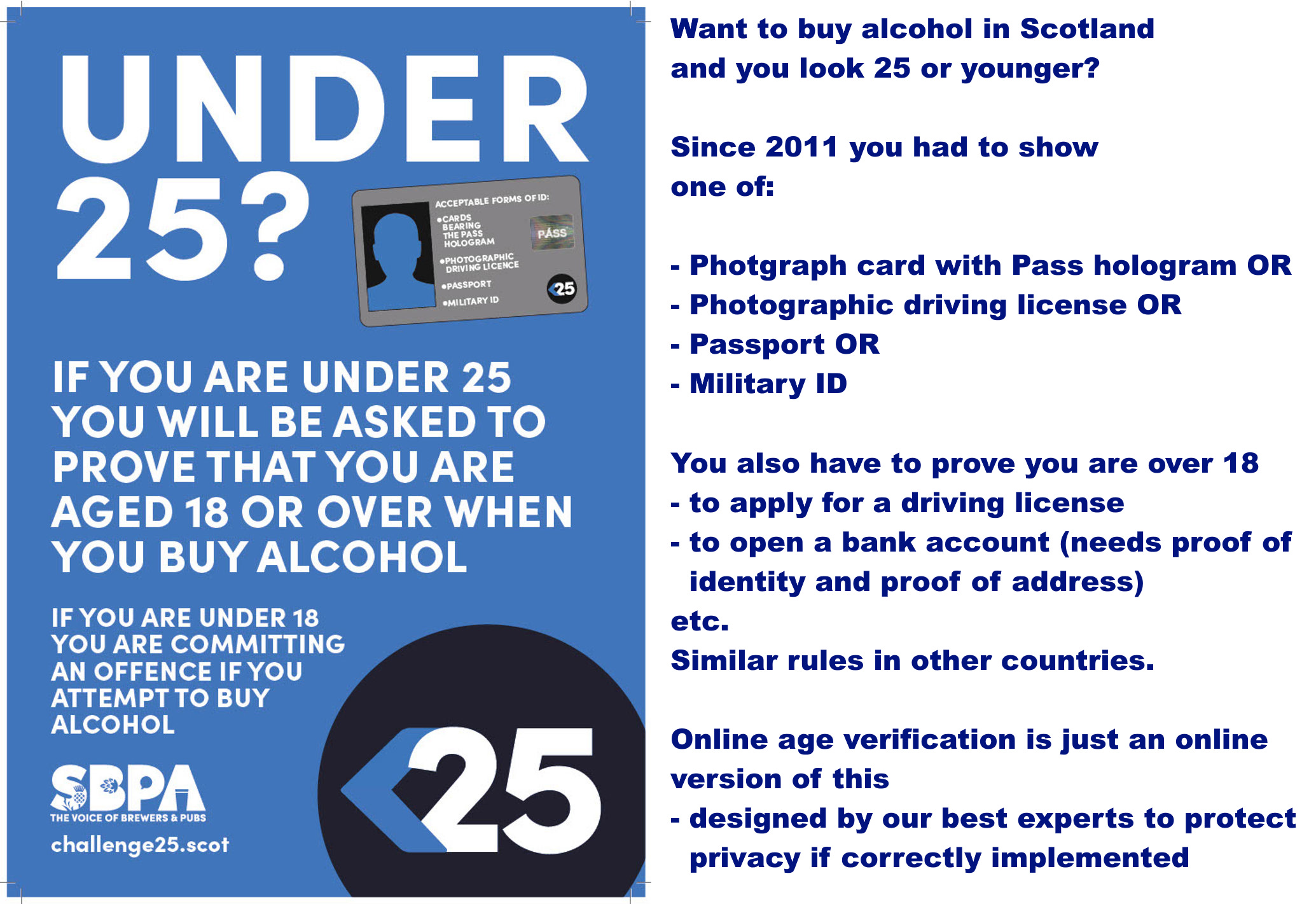
TEXT ON GRAPHIC:
Want to buy alcohol in Scotland and you look 25 or younger?
Since 2011 you had to show one of:
Photgraph card with Pass hologram OR
Photographic driving license OR
Passport OR
Military ID
You also have to prove you are over 18
to apply for a driving license
to open a bank account (needs proof of identity and proof of address) etc.
Similar rules in other countries.
Online age verification is just an online version of this
designed by our best experts to protect privacy if correctly implemented
Graphic from: https://beerandpub.com/sbpa/challenge-25/
What you need to open a bank account: https://www.hsbc.co.uk/current-accounts/what-do-you-need-to-open-a-current-account/
Video for this blog post:
Contents
Example from real life - children can’t buy alcohol
Try comparing this with other things to do with children:
With various limits usually 18+, kids in the UK (and is similar in the USA):
can’t vote
can’t buy alcohol (can drink alcohol at home if their parents permit it - but not buy it)
can’t buy tobacco
can’t buy fireworks
can’t buy e-cigarettes
can’t buy knives or crossbows
can’t have tattoos
can’t drive on public roads (they can drive on private roads e.g. a farmer’s kids may drive his or her tractor)
are restricted in which films they can watch
can’t gamble online / betting shops (18+) or get lottery tickets (16+)
That is actual regulation.
It is nothing to do with parents being too lazy. Parents are not expected and SHOULDN’T follow their kids around everywhere they go in real life. So they CAN’T police this!
It just makes no sense whatsoever in the real world that parents would be responsible for making sure that their kids don’t do any of those things.
They can TELL their kids not to do those things. But they can’t ENFORCE those things.
Well it’s the same with the internet. It is just not practical for parents to keep an eye on where their kids go and what they do on the internet.
They can put some age restriction app on their kids phones - but kids can get around that by using someone else’s phone or buying a new mobile phone if they can afford it or by finding ways to evade the app and so on.
And we can’t expect parents to be tech savvy or to keep a close eye on them on the internet.
It’s just the same as for buying alcohol in shops. There is no way that we could put that on parents. They can’t chaperone their kids to make sure they don’t buy alcohol in shops until they are 18.
Some kids may be able to drive or use social media without need for protection at a very young age - like Ruth Lawrence who could complete a first class degree in maths aged 13 - but we need to set an age limit somewhere
And as I say in the video this can seem unfair to kids.
When I was at Oxford in the 1980s one of the other students in the maths department was Ruth Lawrence. She entered university in 1983 aged 12. She got her maths degree in 1985 aged 13 with a congratulatory first and special commendation. She got a second degree in physics in 1986 and a doctorate in Maths in June 1989 by which time she was still a teenager aged 17 and too young still to buy alcohol or take a driving test.
https://en.wikipedia.org/wiki/Ruth_Lawrence
Well there must be young kids of 12 who similarly would be able to drive a London double decker bus. People who are exceptionally gifted drivers and who have the alertness, situation awareness, understanding of traffic, not going to get distracted, calm and careful drivers. But there is a safety issue there, it’s not like getting a doctorate.
So we have to set a minimum age in law, because we can’t rely on any other method to ensure they are mature enough to drive.
So it’s the same with these internet age-gating online.
Many kids would not get suicidal in Molly Russell’s situation. Many are not going to be bothered by online harms, will have only a positive experience of social media, and are not going to be cyberbullied or engage in cyberbullying and are are not at risk of grooming by strangers either.
But enough are at risk of al those things that we need to have age verification to protect them.
Now you don’t need to agree with this.
But I hope it’s given a better idea of WHY this is happening and why it is happening right now.
Brief history - why it’s happening now rather than a decade or several decades ago - most don’t realize how recently kids first started to use the internet widely
It’s not that long ago that few people even had heard of email :). This is a short video from 1994, the anchors on the US Today show didn’t know how to pronounce the @ sign in an email and they didn’t know what the internet was either.
The first ever email sent by a head of state was sent by the president of Sweden in 1994. He sent it to president Clinton but Clinton’s email address wasn’t yet connected to the system!
There weren’t many connection hubs in Sweden, but we found one in Stockholm. I managed to send Clinton an email to congratulate him on ending the trade embargo with Vietnam—the first digital message between two heads of state.
We waited for a reply, but we didn’t hear back. After several days, one of my staff members called the White House to ask if they had received it. It turned out that they hadn’t connected their system yet!
The Guiness book of records says that president Clinton sent two emails, one as a test, and another with the help of staff to astronaut John Glenn when he was in orbit on the ISS. Obama was the first president to have regular email access.
https://www.guinnessworldrecords.com/world-records/first-president-with-regular-email-access
No previous generation of teenagers has ever spent anything like as much time online. Previous generations of teenagers didn’t even have smartphones and most of them couldn’t go online, just a decade ago.
They could go online possibly at home on their family computer if their household had a computer. And all they typically did back then - as recently as the 1990s was to play computer games very little use of email - very little browsing of the internet and only geeks were involved in things like online discussions with strangers.
Geeks used:
Usenet which goes back to the 1980s
Slashdot didn’t start until 1997
Facebook didn’t start until 2004 and it was NOT used to talk online to strangers. The new thing about Facebook was that it was used to network with people close to you like friends, colleagues, relatives and originally that was its main focus. NOT news at all and NOT talking to strangers particularly.
Twitter was founded in 2006 and that was the first social media to have celebrities that people would follow, at least widely remembered. I remember in the UK, Stephen Fry was an early adopter of Twitter. As was Jonathon Ross.
There were bewildered posts by journalists about their tweets. Why would anyone want to know what Stephen Fry had for breakfast? Or that he is stuck in a lift.
It must be something of a nightmare for a well-known public figure – Stephen Fry, say – to be trapped in a lift with five other people, and then to find his discomfort broadcast minute by minute to thousands of people in the outside world via computer. To worsen the assault on Fry’s privacy, a photograph was taken of him to accompany the messages sent from the front-line.
But here is something odd. It turns out not to have been a self-publicising, celebrity-obsessed stalker exploiting the situation, but Fry himself. An enthusiast of something called Twitter, an online social networking site which allows brief instant messages to be tapped out between friends and fans, Fry has taken to sending out regular reports to fans on his daily doings.
“Ok. This is now mad. I am stuck in a lift on the 26th floor of Centre Point,” he wrote of this week’s great drama. “Hell’s teeth. We could be here for hours. Arse, poo and widdle.” A flurry of messages – or “tweets” – followed this momentous news until Fry and his fellow passengers were rescued. “So many marvellous tweets from you sympathetic (and notable less so) peeps,” read the message at his moment of liberation. “Much appreciated.”
…
This surely is, if not a form of mass insanity, then an extreme expression of personal insecurity. It is as if some evil, judgement-warping rays are emanating from computers, making apparently sane people believe they truly exist only if they are tapping messages to one another, however dreary, throughout the day. The digital presence on the screen of their Blackberrys of “followers” (bored people with nothing to do) and “friends” (whom they have never met) make them feel alive.
https://terenceblacker.com/you-dont-have-to-be-a-twit-but-it-helps/
This is him soon after:
Stephen Fry’s first tweet was
Hello Twitterers. I’m About to fly to Africa for a new project and will be tweeting whilst I’m filming.
https://www.buzzfeed.com/tomphillips/the-first-tweets-of-british-celebrities
https://en.wikipedia.org/wiki/Twitter
We are used to that now and it doesn’t seem strange to us at all but back in 2009, it all seemed very odd to most of us.
But now we think nothing of it, numerous people tweet or post to facebook or talk via Whats App or in one way or another are informing each other constantly about ever little doing of their lives.
But that didn’t cause major issues for kids online either.
What changed things was
smartphones when they got so low cost that every kid has their own personal computer, even preteens have smartphones now
social media when it changed to be like Twitter always was and Usenet and Slashdot - a place where you network with complete strangers globally
algorithms that push things onto your social feed that you haven’t searched for not even by the people you follow or network with
social media feeds being used increasingly as a VERY UNRELIABLE source of “news”
Weren’t many kids very active online until kids had their own smartphones
Though this is happening in many countries globally it’s not a plan or conspiracy and nobody is driving it.
Rather what’s happened is that over the last few years more and more kids are now online at younger and younger ages and it is taking up more and more of their life.
Used to be, first only a few geeks like teachers who teach computing at school had computers. Everyone else only used them at work or at school.
Even earlier when I was at school - the only computers were in research institutions or universities and most people wouldn’t have any interaction with a computer until they went to university or college or if they got one of the rare jobs that required you to use a computer and even then they only interacted via punched cards or a terminal with rolling paper scrolling through it.
And at university or college it would only really be people doing degrees in computing that used the computers. That is what it was like when I went to university in 1972. Anyone could use the computers but hardly anyone did because it was geeky and difficult to use them. I did because from 1971 to 2 I had a gap year job in Culham labs where I learnt programming and helped with very simple programming tasks like punching cards for their work on modelling nuclear fusion.
Later more and more adults had mobile phones. Originally just for voice and text messages. It’s less than two decades ago that they began to have internet on most mobile phones with some pioneering devices in the late 1990s.
Then we had home computers. But go back just a couple of decades and go into any household and typically there’s only one computer. It’s an expensive item and there is one device for the entire family.
That is why we have the option to create many users on our laptops. Nowadays many people only have one user on their device. But used to be normal to have the entire family would have accounts on the same computer and take turns to use it.
And then when they did use it, it was mainly for computer games, some use of email after that started in the late 1990s onwards. But almost no internet browsing especially before Google. It was launched in 1998. Before then the only way you could find new websites is from websites with lists of links and from people sharing links or going from one website to another.
https://en.wikipedia.org/wiki/History_of_Google
Why it took so long to get algorithms filling our feed - just an idea whose time has come
The algorithms also are not someone’s big plan. Although we now have far faster computers and more sophisticated algorithms, I don’t think that’s the reason for the algorithms playing such a large role in our lives. We could have done this way back in the 1980s already in the early days of the internet, if there had been the interest and a strong push to do it.
It’s easier with modern faster servers with far more memory, end users also with far more memory on their computers and the ability to run more complicated algorithms faster
But we could have done a cruder version of it decades ago and never did. So that also is something that is co-evolving with our changing habits.
And another new thing is video. Used to be you couldn’t play video live over the internet. Now people expect to be able to do live streaming video even HD on any device and they don’t need to worry how much it costs when it used to be something you had to monitor and make sure you didn’t watch too much video or you’d be paying hundreds of dollars a month on the video streaming.
And another new thing is that even young kids have mobile devices. Used to be, first only a few geeks like teachers who teach computing at school had computers. Everyone else only used them at work or at school.
Online Safety Act was motivated by the wish to do something about LEGAL online harms especially algorithms that boost self harm videos and videos that encourage eating disorders
This came to a head less than a decade ago with the tragic suicide of Molly Russell in 2017 which the coroner says was partly caused by algorithms pushing things into her feed that she didn’t search for.
https://en.wikipedia.org/wiki/Death_of_Molly_Russell
Although the bill requires reported ALREADY ILLEGAL content to be taken down - as a social media company should be anyway - the bill doesn’t classify any new content as illegal. The online harms it focuses on don’t have to be taken down and the Act was partly inspired by the sad case of Molly Russel who died of suicide. The coroner found that her suicide was partly the result of social media algorithms that encouraged her to binge on content that she hadn’t searched for herself that romanticised suicide and discouraged her from seeking help.
We did it in the UK because of a young girl Molly Russel who died of suicide in 2022. The coroner said that it was partly caused by algorithms that pushed images encouraging suicide into her feed produced by strangers that she never asked for.
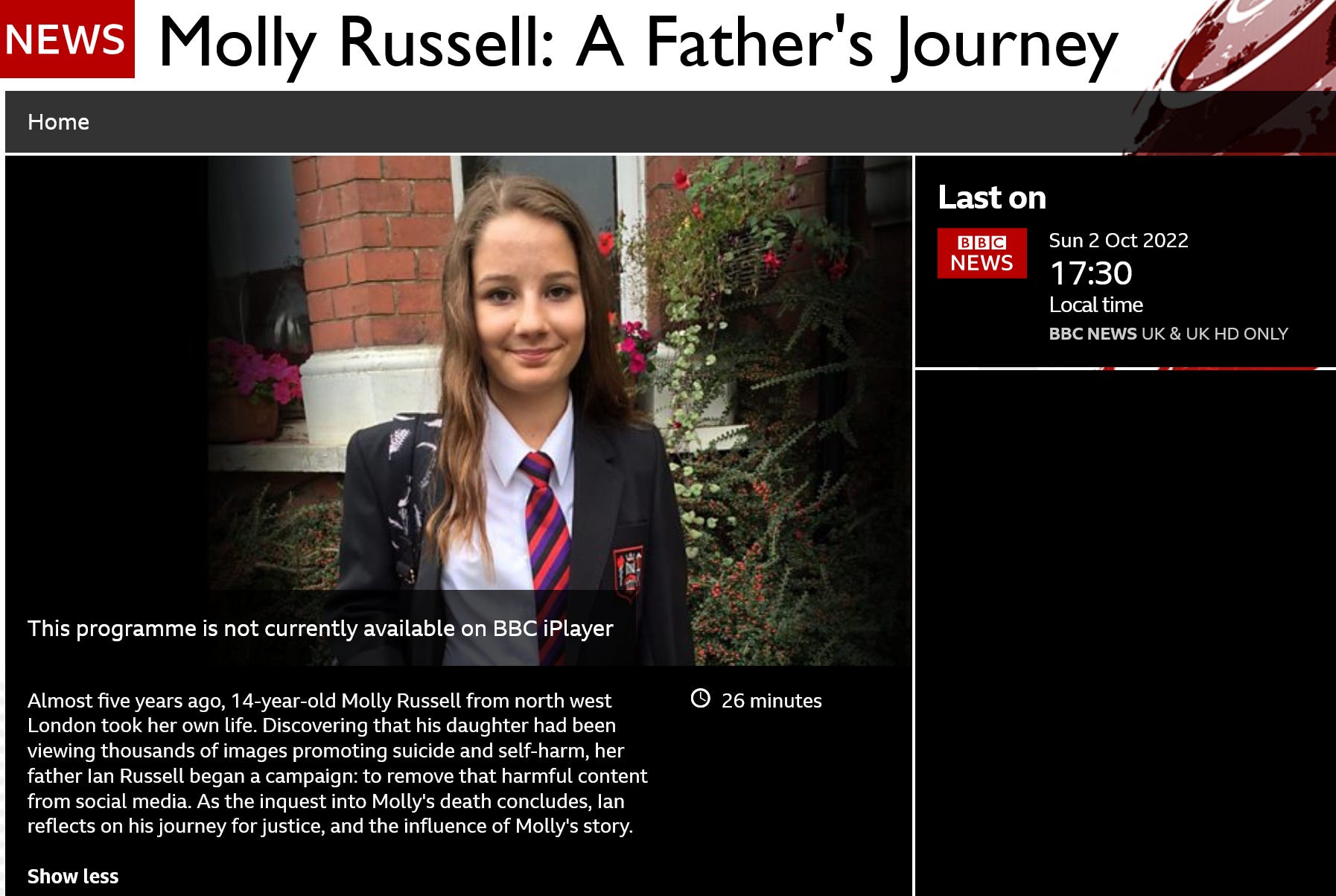
https://www.bbc.co.uk/programmes/m001d6j2
The aim of the act is to reverse these tendencies - to stop the algorithms from boosting such content for kids who aren’t looking for it, and to provide links to support tools to encourage them to seek help.
I go into the background here
So historically we know exactly why the UK passed the Online Safety Act. It is to protect kids. Very clear case. It is not in any way motivated by anything to do with totalitarianism or surveillance and it would be VERY different if those were the aims of the legislators. Indeed to do things like that is against basic rights in the UK so our parliaments could never pass such a law.
Once you can clearly see why they are doing all this then it’s no longer a personal threat. It is something we have had to do because of a shift in how people use the internet and a real problem that has to be solved.
And they have done the best they can to solve it.
So that is what I go into next.
CONTACT ME VIA ddebunked.org OR EMAIL
You can Direct Message me on Substack - but I check this rarely. Better, email me at support@robertinventor.com
OR contact me at our new forum
https://ddebunked.org
Please do NOT Direct Message me on Facebook any more unless you are already in contact with me.
If already in contact on FB then please understand if I don’t reply for a while except to very urgent messages
Try email or other ways to talk to me until this is sorted out.
For now I only want to talk on FB about how to message me somewhere else.
FOR MORE HELP
To find a debunk see: List of articles in my Debunking Doomsday blog to date See also my Short debunks
Scared and want a story debunked? Post to our forum which is set up for voluntary fact checking.
The forum itself is here:
Also do join our forum if you can help with fact checking or to help scared people who are panicking.
Alternatively you can post to our Facebook group. Please look over the group rules before posting or commenting as they help the group to run smoothly
Facebook group Doomsday Debunked
However I am not able to comment or post there at present because
SEARCH LIST OF DEBUNKS
You can search by title and there’s also an option to search the content of the blog using a google search. Try different terms e.g. Russia, Putin etc as it only searches the title.
CLICK HERE TO SEARCH: List of articles in my Debunking Doomsday blog to date
NEW SHORT DEBUNKS
I do many more fact checks and debunks on our Facebook group than I could ever write up as blog posts. They are shorter and less polished but there is a good chance you may find a short debunk for some recent concern.
I often write them up as “short debunks”
See Latest short debunks for new short debunks
I also tweet the debunks and short debunks to my Blue Sky page here:
I do the short debunks more often but they are less polished - they are copies of my longer replies to scared people in the Facebook group.
I go through phases when I do lots of short debunks. Recently, I’ve taken to converting comments in the group into posts in the group that resemble short debunks and most of those haven’t yet been copied over to the wiki.
TIPS FOR DEALING WITH DOOMSDAY FEARS
If suicidal or helping someone suicidal see my:
BLOG: Supporting someone who is suicidal
If you have got scared by any of this, health professionals can help. Many of those affected do get help and find it makes a big difference.
They can’t do fact-checking, don’t expect that of them. But they can do a huge amount to help with the panic, anxiety, maladaptive responses to fear and so on.
Also do remember that therapy is not like physical medicine. The only way a therapist can diagnose or indeed treat you is by talking to you and listening to you. If this dialogue isn’t working for whatever reason, do remember you can always ask to change to another therapist and it doesn’t reflect badly on your current therapist to do this.
Also check out my Seven tips for dealing with doomsday fears based on things that help those scared, including a section about ways that health professionals can help you.
I know that sadly many of the people we help can’t access therapy for one reason or another - usually long waiting lists or the costs.
There is much you can do to help yourself. As well as those seven tips, see my:
BLOG: Breathe in and out slowly and deeply and other ways to calm a panic attack
BLOG: Tips from CBT
— might help some of you to deal with doomsday anxieties
PLEASE DON’T COMMENT HERE WITH POTENTIALLY SCARY QUESTIONS ABOUT OTHER TOPICS - INSTEAD JOIN OUR NEW FORUM ddebunked.org
PLEASE DON’T COMMENT ON THIS POST WITH POTENTIALLY SCARY QUESTIONS ABOUT ANY OTHER TOPIC:
INSTEAD PLEASE COMMENT IN OUR NEW FORUM HERE:
It’s just a forum not social media. No age verification. Set up by myself with free open source software Flarum.
For details:

If you have any issues joining it do let me know.
Why I ask you to post to our forum with anything scary off topic instead of here
The reason I ask you to post there instead of comment with your concerns about unrelated topics here is that I often can’t respond to comments here for some time. The unanswered comment can scare people who come to this post for help on something else
Also even an answered comment may scare them because they see the comment before my reply.
Do comment here with anything that is on topic for this post, E.g. if you spot any mistakes however small please let me know.
Also, though your first comment should be on topic, it is absolutely fine to digress and go off topic in conversations here in a natural way if that is how the conversation develops.
This is specifically about off topic comments here hat might scare people on a different topic.
PLEASE DON’T TELL A SCARED PERSON THAT THE THING THEY ARE SCARED OF IS TRUE WITHOUT A VERY RELIABLE SOURCE OR IF YOU ARE A VERY RELIABLE SOURCE YOURSELF - AND RESPOND WITH CARE
This is not like a typical post on substack. It is specifically to help people who are very scared with voluntary fact checking. Please no politically motivated exaggerations here. And please be careful, be aware of the context.
We have a rule in the Facebook group and it is the same here.
If you are scared and need help it is absolutely fine to comment about anything to do with the topic of the post that scares you.
But if you are not scared or don’t want help with my voluntary fact checking please don’t comment with any scary material.
If you respond to scared people here please be careful with your sources. Don’t tell them that something they are scared of is true without excellent reliable sources, or if you are a reliable source yourself.
It also matters a lot exactly HOW you respond. E.g. if someone is in an area with a potential for earthquakes there’s a big difference between a reply that talks about the largest earthquake that’s possible there even when based on reliable sources, and says nothing about how to protect themselves and the same reply with a summary and link to measures to take to protect yourself in an earthquake.
This is the first of a series of posts on the topic. The next is about HOW the industry leaders protect privacy. It will show technically how they protect privacy. It should reassure you that this is possible. This also is the top priority of both the UK and Australia, to make sure that age verification protects privacy.
The UK and Australian governments are not accused of any human rights abuse or surveillance or any cases of abusing the system. It is designed to make that impossible.
If any of you know of an example of a government that has used age verification to abuse human rights or to breach privacy please say and I'll investigate and talk about lessons learnt and how to prevent it etc. I would not omit anything like that but simply haven't found it.
Please do respond if you know of anything I need to cover.
I want to give scared people accurate advice and don't want to leave anything out that they need to know about.
I am a voluntary fact checker and when people say such things I fact check them and have found no facts to support the claims.
PLEASE DON’T COMMENT ON THIS POST WITH POTENTIALLY SCARY QUESTIONS ABOUT ANY OTHER TOPIC
Also please check the purpose of this substack - to help people scared of many things. Welcome:
- questions if you are still scared and need help
- fact checks if I got anything wrong however small
- help with debunking
Please don't post potentially scary things here unless you are yourself scared and needing help.
FOR POTENTIAL SCARY QUESTIONS ABOUT OTHER TOPICS YOU WANT DEBUNKED - PLEASE COMMENT IN OUR NEW FORUM HERE
https://ddebunked.org
There are many there who can answer you not just me. And it is setup for voluntary fact checking and far easier to use than comments here
https://ddebunked.org
It’s just a forum not social media. No age verification. Set up by myself with free open source software Flarum.
For details see my:
https://robertinventor.substack.com/p/our-own-new-discussion-forum-for
We only need your user name and email address to join and the email address is just for notifications, we don't look at it (unless needed to help you or for debugging) or share with anyone.
If you have any issues joining it do let me know.