
South Florida branching corals rescued after 2023 heatwave and replanted and these species grow back in years to a decade - some branching corals survived even in south - NOT any risk of extinction
Indeed long term the future prospects are very positive with potential for a revival / renewal as global warming slows down as the corals did in the Holocene optimum 3000 to 5000 years ago

I’m debunking this claim: https://wsvn.com/news/local/florida/critical-florida-corals-now-functionally-extinct-due-to-off-the-charts-ocean-temperatures/ Critical Florida corals now ‘functionally extinct’ [FALSE - WOULD BE LOCALLY UNABLE TO RECOVER ONLY IF WE DID NOTHING TO HELP THEM] due to off-the-charts ocean temperatures [WERE RECORD TEMPERATURES BUT NOT OFF THE CHARTS THOUGH WARMER THAN PREVIOUS RECORDS]
This is a one-sided article that leaves out all we are doing and also all that nature is doing by itself to solve it!
UPDATE: Turns out that this goes back ot the paper itself. I’ve now bought the paper and read it, and the paper has 100% negative framing. It talks about the coral restoration successes pre 2023 but leaves out ALL the coral reef restoration successes after the 2023 bleaching event. I’ve added a section about it near the end.
This is a scenario where we continue to produce more and more CO2 every year increasing coal burning - until warming is so fast we get coral bleaching every year by the 2040s. This is not even remotely possible now.
On the low emissions paths the prospect for the future is far more positive.
The paper also doesn’t explain how quickly the branching corals can reach maturity, it’s 3 to 5 years for the staghorn corals, 10 to 12 years for the elkhorn corals and then with modern techniques even much slower growing corals can reach maturity in as soon as 3 years.
Then, after reading the paper and digging into it some more, the situation is far more positive than I realized.
The paper explains in a historical paragraph that the Florida reefs were at their maximum in the Holocene optimum a warm period from 3000 to 5000 years ago. They almost stopped growing since then. They are actually at the cold edge of where coral reefs are possible at all.
The paper explains all this but doesn’t draw out the implications of it.
Given that global warming will soon slow down on the 1.7 C never mind the 1.5 C path, then this is likely the most difficult time for them to adapt and after getting through this, they face a future of far better conditions for coral reefs than at any time in the last 3000 years or more.
Given also all the research that’s being done on coral restoration and how we can help this process - the prospects are very positive for coral reefs long term on the low emission path we are following.
Similarly the prospects for corals globally are very positive on a low emisisons scenario which we are on.
I end with an Perpelxity AI generated list of the major coral restoration projects globally in Hawaii, Australia, the Red Sea, the Caribbean, India, Phillipines, and so on (leaving out Florida as the article already covers it).
Psychologists say for maximum engagement and action we need a ratio of 3 positive framing for each negative threat discussed. This paper has a ratio of 0 positive framing for each threat.
What I’m doing here is positive framing which will actually lead to MORE not less engagement and action. Positive framing is truthful, it gives the broader context to let you see how much hope there is and how much is already being done.
Contents
Common Themes About Coral Reef Restoration and Preservation in Florida:
Corals rescued in 2023 by innovative “coral bus” protecting 83 elkhorn and 118 staghorn genotypes from extinction
The situation for Florida corals is VERY POSITIVE.
First, this is about how the branching corals were rescued in 2023. I wrote this when the heatwave happened:
BLOG: The Coral Reef Restoration Foundation acted swiftly to save corals from their coral nurseries from the marine heat wave, moved them to big marine aquariums on land where they will grow for several months then get returned to the sea
You can read it here:
https://debunkingdoomsday.quora.com/The-Coral-Reef-Restoration-Foundation-acted-swiftly-to-save-corals-from-their-coral-nurseries-from-the-marine-heat-wave
This is based on my answer in our new forum here, do check it out: https://ddebunked.org/d/188-coral-dying/7
It’s a good time for an update and now I’ve got Perplexity AI which is great at finding these things. So I asked it to follow up to find out what happened to the rescued corals. It found many sources that described how they survived and were planted out and are flourishing in the Florida reefs.
The conservation work - not only rescued many branching corals - it rescued the full genetic diversity, and it helped to heat adapt them.
In 2023, they used their innovative “coral bus” to transport the corals to safety
QUOTE STARTS
The Coral Bus is a first-of-its-kind coral transport technology that closely replicates the open ocean conditions to which the corals are already acclimated. The state-of-the-art aquarium trailer enables practitioners to monitor and regulate water temperature, pH, filtration, and water flow to ensure the well-being of corals during transport, minimizing the stress experienced by these fragile animals while they are on the move
…
The Coral Bus was critical in our successful move of 417 of our elkhorn and staghorn corals, spanning 83 and 118 unique genotypes respectively, as well as 484 colonies of our brain, pillar, and star corals. Together with NOAA and fellow restoration experts, we managed to safeguard a total of 350 genotypes of the critically endangered staghorn and elkhorn corals, banking duplicate representatives of each genet at both Mote Marine Laboratory in Sarasota and the The Reef Institute in West Palm. With all genotypes represented in both institutions, we are ensuring that this precious genetic material is safeguarded in redundant systems.
https://coralrestoration.org/wp-content/uploads/2024/10/CRF2023_Annual-Report.pdf
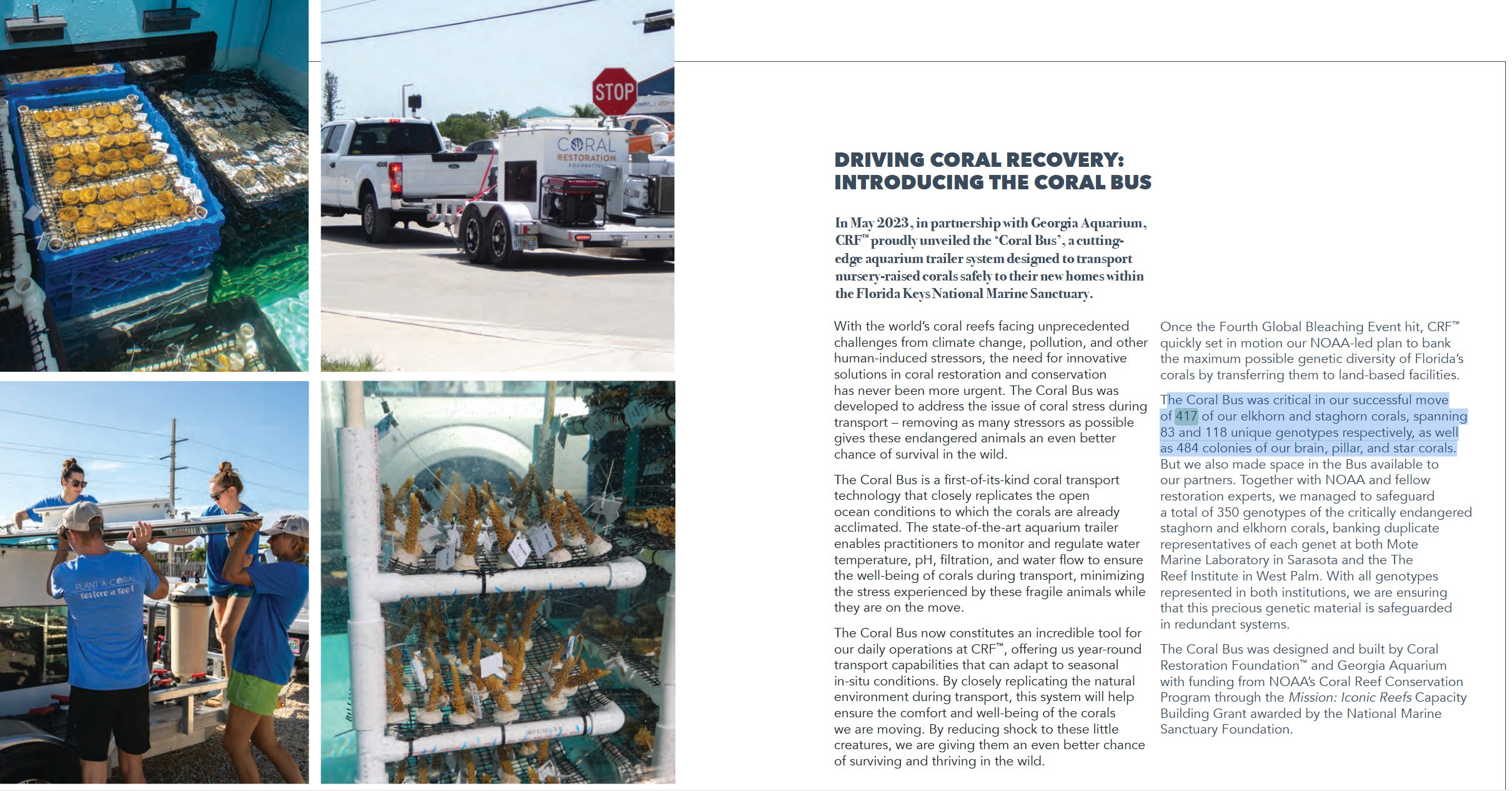
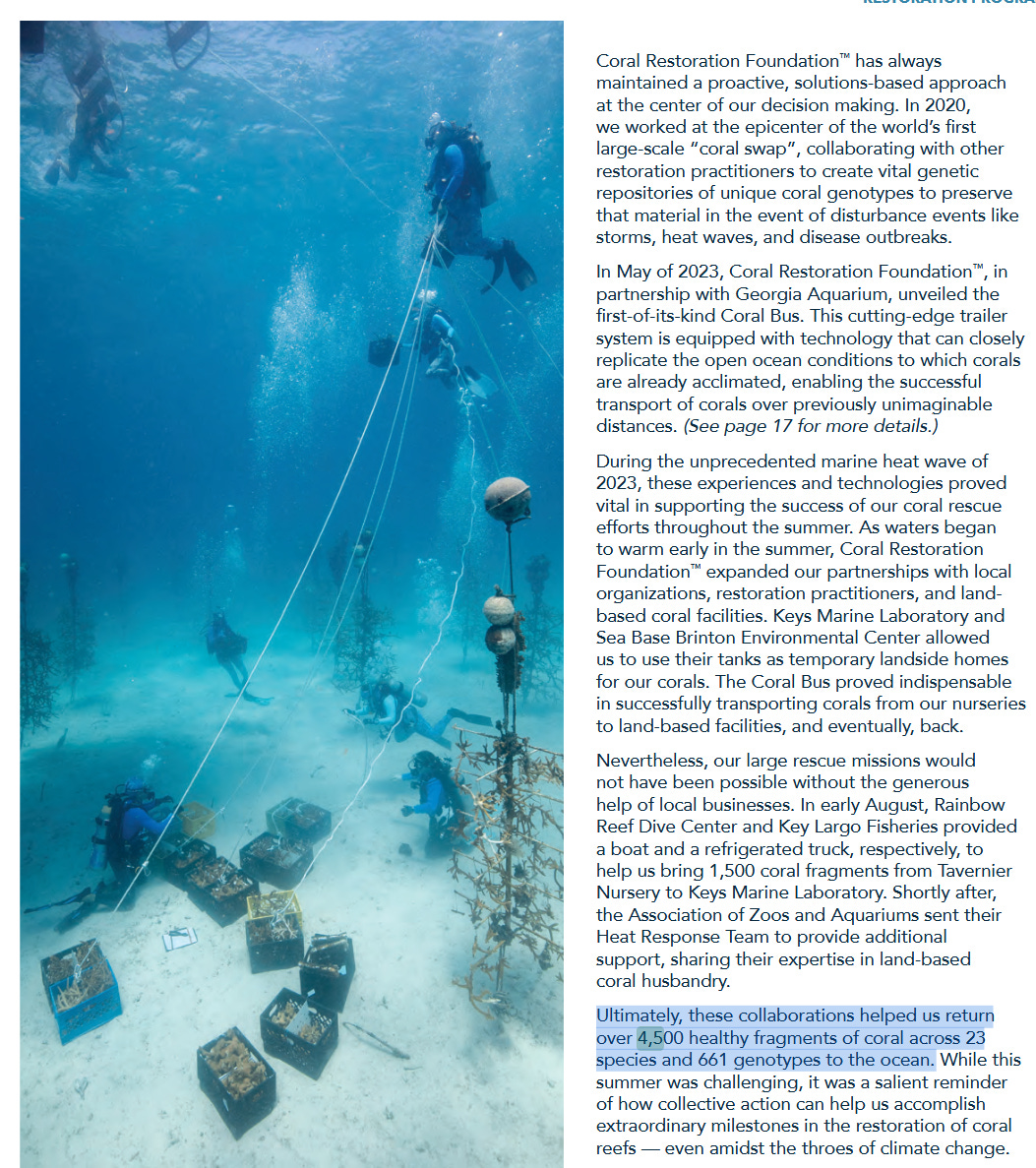
Ultimately, these collaborations helped us return over 4,500 healthy fragments of coral across 23 species and 661 genotypes to the ocean.
https://coralrestoration.org/wp-content/uploads/2024/10/CRF2023_Annual-Report.pdf
Some remarkably resilient staghorn and elkhorn species showed no bleaching and didn’t need to be rescued even in warmer Southern Florida - though they removed fragments to use to help recolonize elsewhere
They also found some remarkably resilient urban staghorn and elkhorn species that showed no bleaching at all after the heat wave and didn’t need to be rescued even in the warmer Southern Florida.
Researchers found 43 living staghorn corals in the worst affected area in south of Florida
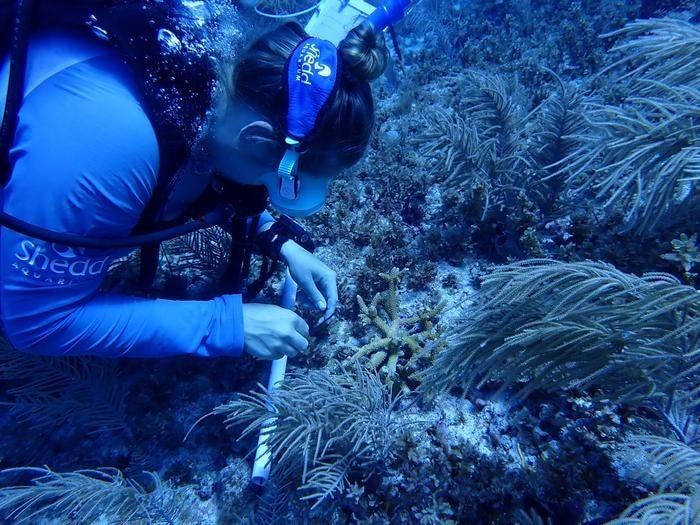
On a recent research trip to the Dry Tortugas, Shedd Aquarium scientists rescued the only known staghorn coral survivors in the area after last year’s devastating bleaching event in the Florida Keys. The remarkable discovery of live staghorn coral colonies is crucial for the future of this critically endangered species, enabling additional research on coral heat tolerance and restoration.
Shedd’s research team found 43 living colonies of staghorn coral and utilized the aquarium’s research vessel, the R/V Coral Reef II, to safely transport small, living fragments back to land-based facilities to further safeguard the species.
https://www.eurekalert.org/news-releases/1068441
This is an example of the unexpected resilience of corals that researchers have found worldwide.
BLOG: Coral reefs are MORE RESILIENT than we thought in 2018 not less so
— the Global Tipping Points report is by an advocacy group of scientists not evidence driven science
You can read it here:

Orchestrated a baby boom for corals in 2025
Corals have lots of babies and they have orchestrated a baby boom for Florida in 2025
Most Reliable Sources on Recent YouTube Videos About Coral Reef Restoration and Preservation in Florida
I know that the coral researchers do lots of videos about the Florida corals so I asked Perpleity AI to find the best most reliable sources from August 2025 (since they do videos frequently), and this is what it found.
I used the SCBD template I developed to get it to find quotes - when using this template it is very accurate nearly always.
1. Mote Marine Laboratory Florida Keys Coral Nursery
Published: August 6, 2025
Organization: Mote Marine Laboratory & Aquarium
Key Quote: “Since 2008, Mo has outplanted over 220,000 corals, many of which are now reproducing on coral reefs... Thanks to this method, we’re able to grow corals in under 2 years to a size that would normally take a century.”
Summary: This video showcases Mote’s land-based coral nurseries in the Florida Keys using micro-fragmentation techniques that allow corals to grow 25-50 times faster than naturally. The facility uses filtered seawater systems with isolated raceways to protect healthy corals from disease. Features both asexual and sexual reproduction methods, international gene banking, and mass-production capabilities.
Bias/Credibility: Institutional video from established nonprofit research organization (founded 1955). Highly credible scientific source. Focuses on positive outcomes and technological solutions.
Date: August 2025
URL:
2. Where We Grow: Coral Planting in Florida!
Published: October 8, 2025
Organization: SeaTrees (in partnership with Plant a Million Corals)
Key Quote: “We’ve actually got just a little over 50,000 corals that we’ve grown right here, right now. Right here, right now in our 36 tanks... We’re planting 10 or 20 corals in one piece and one movement and that’s will allow us to plant thousands of corals in one day not just hundreds.”
Summary: Features Dr. David Vaughan and his daughter Dee Dee demonstrating micro-fragmentation and reskinning techniques at their land-based coral farm in the Florida Keys. Shows how they’re growing 50,000+ corals across 36 tanks and developing innovative “wet chain” deployment methods using specially designed acrylic tanks that can be lowered directly to divers. Highlights 3,000 corals being grown for SeaTrees with Samsung partnership. Includes coral survivors from 2023 heat wave being propagated for resilience.
Bias/Credibility: Nonprofit conservation organization video with educational/promotional purpose. Features established coral scientist Dr. David Vaughan (pioneer of micro-fragmentation). Very credible with transparent operations.
Date: October 2025
URL:
3. Marine Researchers Lead Coral Conservation Efforts in Florida
Published: August 18, 2025
Organization: CBS 12 News (WPEC)
Key Quote: “Data from last year’s Coral research season showed positive change in the 41 sites surveyed in Palm Beach and Martin counties... the corals overall were much healthier than the previous year, and we saw a lot less disease.”
Summary: News report covering Palm Beach Zoo dive team’s coral monitoring work showing that northern Florida reefs (Palm Beach/Martin counties) are healthier due to deeper, cooler waters. Documents recovery and reduced disease compared to southern Keys. Features underwater footage of vibrant reefs with abundant marine life including nurse sharks, moray eels, and stingrays, indicating healthy ecosystem function. Emphasizes that northern reefs could be part of long-term restoration solution.
Bias/Credibility: Local news journalism from CBS affiliate. Balanced reporting with scientist interviews. Credible regional news source.
Date: August 2025
URL:
4. Florida Matters - The Future of Florida’s Coral Reefs
Published: September 23, 2025
Organization: WUSF Public Media
Key Quote: “Recently in partnership with the University of Miami, we were able to import some elkhorn coral fragments from a very hot bay off the coast of Honduras called Tel Bay and crossbreed those with Florida’s elkhorn coral. And so we have now a couple hundred babies that may have this new genetic composition that now has genes from this very warm area in Honduras.”
Summary: Extended interview with Keri O’Neil, Director of Florida Aquarium’s Coral Conservation Program, discussing coral restoration efforts including breeding heat-tolerant “Flonduran” corals (Florida-Honduras hybrids), induced spawning in laboratories, and sexual reproduction to create genetic diversity. O’Neil discusses witnessing healthy reefs worldwide and maintaining hope through innovative interventions including stress memory research and selective breeding. Discusses 30 years of coral restoration practice in Florida and evolution from asexual to sexual reproduction methods.
Bias/Credibility: Public media (NPR affiliate) long-form interview format. Highly credible journalism with expert scientist. Balanced presentation acknowledging both challenges and solutions.
Date: September 2025
URL:
5. Saving Corals: How Shedd Is Helping Restore 1 Million at a Time
Published: September 18, 2025
Organization: Shedd Aquarium
Key Quote: “By putting these spawning nets over the corals, we’re able to collect those gametes in these tubes, bring them back to the boat, and then mix those gametes together, allow them to fertilize and then grow them up in the system right here... it’s really great that we’re able to use the live well system to do a lot of the fertilization ASAP right here on the boat.”
Summary: Short video featuring Research Biologist Dr. Shayle Matsuda discussing coral spawning research aboard Shedd’s research vessel Coral Reef II in the Florida Keys. Shows innovative on-boat fertilization system that reduces stress on fragile gametes by eliminating transport time to shore. Partners with Coral Restoration Foundation to collect coral spawn during the narrow annual spawning windows (often just 1-2 nights per year).
Bias/Credibility: Major accredited aquarium institution (Chicago). Highly credible scientific organization with long research history. Promotional but scientifically accurate.
Date: September 2025
URL:
6. Coral Relocation and Dredging Mitigation with The UM Coral
Published: July 13, 2025
Organization: The International SeaKeepers Society (with University of Miami Coral Reef Futures Lab)
Key Quote: “Over the course of three outings aboard SeaKeepers’ vessel, DISCOVERY II, research teams successfully collected 86 corals. All collections were conducted under the Florida Fish and Wildlife Conservation Commission’s Stock Collection and Release Special Activity License.”
Summary: Documents coral rescue operation from June 25-27, 2025 at Port Everglades, Fort Lauderdale, where 86 corals were carefully collected from areas slated for dredging impact. Corals were transported to University of Miami’s ex-situ nursery, where they will be fragmented, mounted, and either outplanted to artificial reefs, nearshore reefs, or kept in nurseries for 6-month grow-out. Shows responsible permitting and collaboration between conservation groups and development projects.
Bias/Credibility: Nonprofit marine conservation organization partnering with university research lab. Credible, transparent about permits and process. Focuses on proactive conservation.
Date: July 2025
URL:
Common Themes About Coral Reef Restoration and Preservation in Florida:
Technological Innovation: Multiple organizations using micro-fragmentation, sexual reproduction/spawning, induced breeding, and selective breeding for heat tolerance
Genetic Diversity Strategies: Crossbreeding with corals from hotter regions (Honduras), preserving diverse genotypes, and using sexual reproduction to create new genetic combinations
Scale and Speed: Operations growing 50,000+ corals simultaneously, planting thousands per day using innovative deployment methods, and accelerating growth 25-50x natural rates
Regional Differences: Northern Florida reefs (Palm Beach/Martin counties) showing better health and recovery than southern Keys due to deeper, cooler waters
Collaboration: Partnerships between aquariums, universities, nonprofits, NOAA, state agencies, and private funders enabling large-scale conservation
Survivor Selection: Prioritizing corals that survived 2023 heat wave for propagation to build heat-resistant populations
Hopeful Outcomes: Hundreds of thousands of corals outplanted, many now reproducing naturally; rescued species spawning in labs; reduced disease in monitored areas
More sources here
https://www.perplexity.ai/search/what-happened-to-the-rescued-c-ywn6V2mESpilg_pwSnnQwg#3
So - corals are proving far more resilient than many thought and with helping hands from coral researchers we can make sure Florida still has branching corals in a warmer world. Only slightly warmer and they can adapt, it just takes time.
Reason for hope - corals do well in a warming world and we do not risk sudden warming, the opposite - that warming rates will slow down in near future on the 1.7 C path we are currently following with 1.5 C still well within reach
As to why they don’t explain this, it may be activist, the idea that if you make things seem very negative perhaps people will do more about it.
But in reality it’s positive stories like these that inspire people to act and do more to help.
BLOG: How to motivate your self, and others to act on climate change, biodiversity or anything else
— tips from psychology
— e.g. for maximum engagement present 3 positive or supporting framings for each climate threat
You can read it here:
https://debunkingdoomsday.quora.com/How-to-motivate-your-self-and-others-to-act-on-climate-change-biodiversity-or-anything-else-tips-from-psychology
It’s important to realize that the conditions in Florida are COOL for corals. Florida is right at the cool edge of the temperature range where corals flourish. The warmest corals are in the Red Sea but they are pre-adapted to very hot conditions from an accident of past history so they are okay.
It’s not about the temperature limits for corals themselves.
It is about the temperature limits of the coral species local to Florida.
And rescuing them in aquaria and returning them gives them that time.
There is more and more research and activity like this showing that corals actually do very well in a warmer world with help.
BLOG: Reason for hope for corals that many more survive at 2 C than previously thought
— much quoted figure of 99% lost at 2 C based on study from 2016
— recent research suggests many corals may be more resilient
You can read it here:
https://debunkingdoomsday.quora.com/Reason-for-hope-for-corals-that-many-more-survive-at-2-C-than-previously-thought-much-quoted-figure-of-99-lost-at-2-C
A warmer world actually has a larger area habitable for corals than a cooler world.
There aren’t any warming tipping points from ANY source, methane or anything else. Many don’t realize, for a warming tipping point you need to trap or absorb as much extra heat as a warmer world radiates. That is VERY HARD to do.
Virtually impossible by IPCC IPCC AR6 / WG1 / Ch 7.4.2.7 Synthesis page 7–73:
And the issue is the speed of the warming not the end result. The world is far more habitable now for humans than it was in the last ice age with glaciers covering a lot of the potential agricultural land in the northern hemisphere.
It actually continues to be more habitable not just for us but for biodiversity generally at least for low levels of warming beyond the present. As we approach and exceed 3 C if we get that far we lose the coral reefs but before then on low emissions it becomes a better world even for coral reefs, our most vulnerable ecosystem, so long as the warming is slow enough for them to adapt.
On low emissions the issue is the speed of the warming not the end result. As we reduce emissions per year the speed of warming will slow down more and more greatly reducing that risk by the mid century and then when we reach net zero then the warming stops.
BLOG: The warming of the Anthropocene has benefited the world in many ways - the issue is the speed of change and we likely wouldn’t want to go rapidly back to preindustrial from 1.8 C
We are increasingly on the path that’s kept 1.5 C feasible and we are headed for well below 2 C so long as countries keep to their net zero commitments - and the majority of countries including the big emitters do keep to or indeed increase on their climate commitments.
The IPCC in Brazil will focus on the target of tripling renewables by 2030 amongst others.
I know the USA withdrew but this has barely any difference globally because it already has falling emissions and has already shifted irreversibly towards renewables despite Trump’s efforts to go back the other way.
The branching corals grow far faster than most corals: staghorn reach maturity in 3-5 years and elkhorn in 10 - 12 years
fast the branching corals grow. Here is a 619 day timelapse, which covers the 2023 bleaching event near the start. Some of the corals bleach and recover. But notice how fast the branching corals grow in just 619 days, less than two years.
This video shows how much the faster corals grow in just 9 months
That’s partly why the Great Barrier Reef is so rich in branching corals. The crown of thorns starfish which is devastating in other places is native there and regularly has population booms and eats large parts of the reef - but this helps with the diversity of the corals because it encourages the faster growing branching corals.
I go into that here:
BLOG: Great barrier reef lost half its corals
— they have a recovery plan
You can read it here:
https://debunkingdoomsday.quora.com/Great-barrier-reef-lost-half-its-corals-but-they-have-a-recovery-plan
The Great Barrier Reef branching corals grow especially fast, faster that the Florida ones, but the Florida branching corals grow pretty fast too. The Hawaian branching corals are compartively slow though still faster than the massive corals.
There are two types of corals.
slow growing massive corals where the coral body is inside the skeleton.
fast growing branched corals where the coral body covers the outside of the skeleton.
The elkhorn and staghorn are fast growing corals and within a few years will be back to normal, maturity from a few years to 10 to 12 years.
Staghorn, 3 to 5 years to maturity
QUOTE Staghorn corals thrive in coral reefs at depths ranging 0-30m. … Acropora cervicornis can take approximately 3-5 years to become sexually mature, and can then live another 4-7 years
They grow very fast, branches grow sideways by up to 8 inches per year
QUOTE STARTS
Staghorn coral reaches reproductive maturity at about 7 inches tall. Staghorn coral can also form new colonies when broken pieces, called fragments, re-attach to hard surfaces.
…. Staghorn coral is one of the fastest growing corals—when healthy, it can grow up to 8 inches in branch length per year.
https://www.fisheries.noaa.gov/species/staghorn-coral
[the 7 inches is sideways branching growth, the 7 inches tall is vertical which is why it takes 3 to 5 years to reach maturity]
Elkhorn 10 to 12 years to maturity
QUOTE STARTS
Since early 2019, the CATS program collaborates with CLEAR Caribbean on a coral restoration project in the ‘Soufrière Marine Management Area’ (SMMA) in Saint Lucia. The project aims at propagating Elkhorn (Acropora palmata) and Staghorn corals (Acropora cervicornis) along the coastline in Soufriere all the way from Anse Chastanet Bay to the Pitons. The corals are grown on artificial trees made of PVC pipes and glass fiber bars and are anchored to the ground with ropes. So far, a total of ten trees have been installed, building an underwater coral forest.
The trees, six of which are used for Elkhorn and four for Staghorn, are accommodating approx. 1,000 specimens ranging in size from just a few centimeters to up to almost forearm length with numerous branches.
CLEAR Caribbean uses fragments of healthy coral, collected from different locations in Laborie Bay (south of Soufriere) and the Soufriere Bay itself, and ties them to the nursery trees.
Over time, the fragments grow into healthy and strong corals.
The age difference between the smallest and largest pieces seen in the video might only be about nine months to one year, indicating that these corals grow relatively fast. After about a year, the corals are taken from the trees and transplanted onto the actual reef. So far, about 500 pieces of Staghorn coral have been planted in 50 clusters to the reefs at the bottom of Petit Piton and Pinnacle Point.
This is more about the elkhorn
QUOTE STARTS
Elkhorn coral reaches reproductive maturity at about 2 square feet. … Elkhorn coral can also form new colonies when broken pieces, called fragments, re-attach to hard surfaces. Elkhorn coral is one of the fastest growing corals—when healthy, it can grow up to 5 inches in branch length per year.
https://www.fisheries.noaa.gov/species/elkhorn-coral
“Colonies reach maximum size in about 10 to 12 years. Coral age can be determined by counting coral growth rings the same way that tree rings are counted.”
https://www.nps.gov/drto/learn/nature/elkhorncoral.htm
With help from researchers, even slow growing massive corals can reach maturity after replanting in the wild in 5 years instead of 20 to 30 years
But researchers can grow the massive corals faster too. This one normally take 20 to 30 years or more to grow but with modern techniques, it reached maturity able to spawn in Florida in 5 years in August 2020 after first being planted out in 2015. They did this with microfragmentation, fusion and reskinning - where they cover dead corals with a skin of fragments of living corals of a similar species which are then able to fuse with the dead coral to produce new living coral that reaches maturity much faster.
This is a photograph of the spawning event.
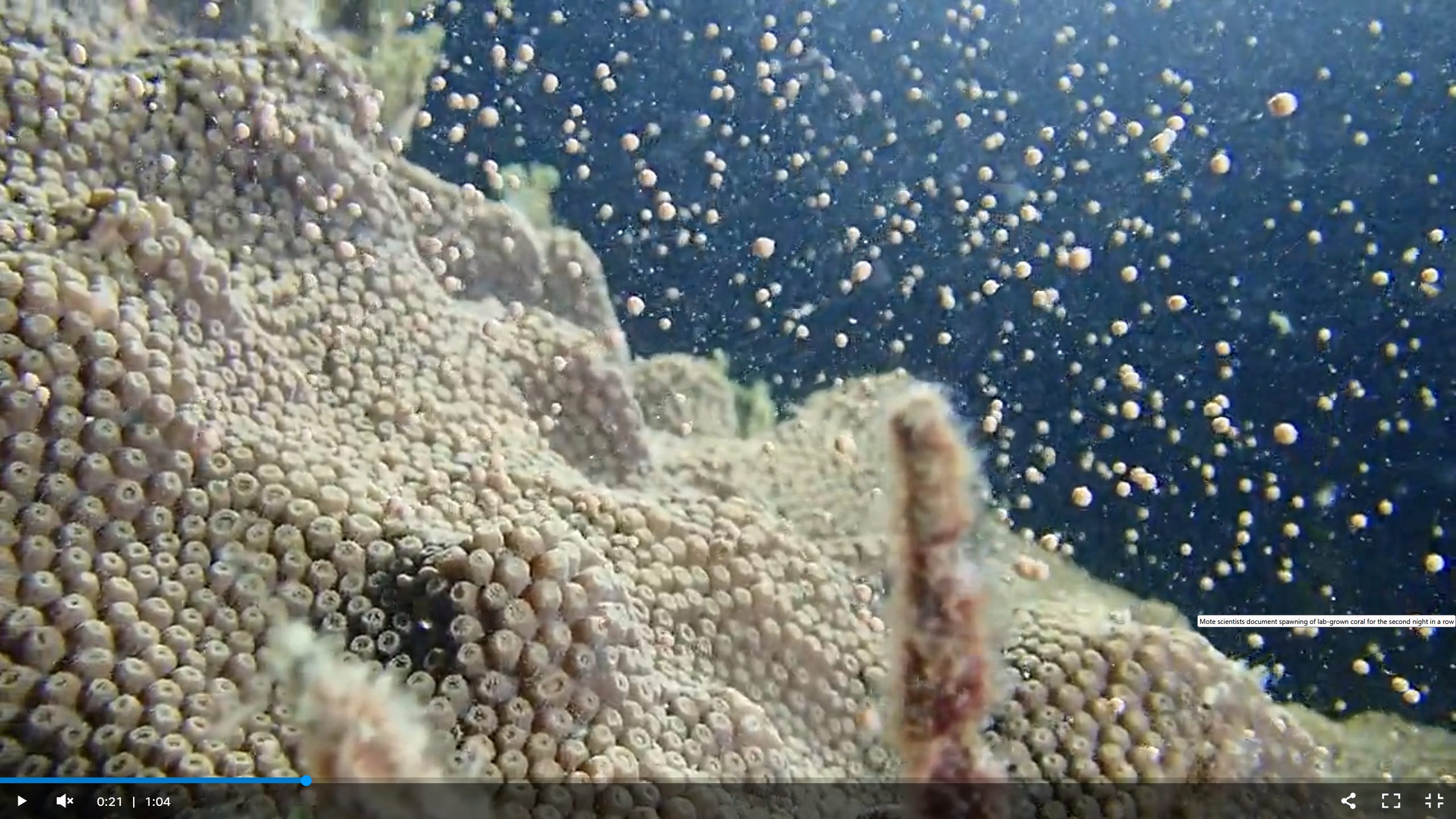
It’s a frame from the video embedded here, from 21 seconds in.
Mote scientists documented the spawning of Mountainous star coral that was grown in a land-based nursery and outplanted in 2015.
…
On Aug. 9 and 10 (2019), Koch and other scientists observed the colonies of mountainous star coral, technically known as Orbicella faveolata, releasing their gametes into the water column.
…
The overall process, now dubbed microgragmentation-fusion, includes the natural process where coral of similar genotypes fuse.
…
A little more than five years after being planted on a reef in the Florida Keys, the mountainous star coral grown in a lab by Mote joined its natural counterparts in a spawning event this week.
That accelerated process is one key to the success of Mission Iconic Reef, which has a goal of increasing coverage on those seven iconic reefs from the current 2% to as much as 25% by 2035.
more about it here:
“These slow-growing coral are the backbone of our coral reefs in Florida and around the world and this incredible breakthrough led by Mote Postdoctoral Fellow scientist Dr. Hanna Koch and her colleague Dr. Erinn Muller has been the first time to document that science actually can be used to restore these slow-growing coral species in just a matter of years through a new innovative technology of microfragmentation and reskinning,” said Mote President & CEO Dr. Michael Crosby.
https://eu.heraldtribune.com/story/news/2020/08/07/coral-grown-mote-laboratory-summerland-key-now-ready-spawn/3316416001/
This is about the microfragmentation method they used
https://eu.heraldtribune.com/story/news/environment/2020/08/12/mote-marine-scientists-observe-lab-grown-coral-spawning-wild/5581336002/
In short, with help the Florida reefs can be covered in branching corals again pretty soon, within a year or two they will be obvious and after 10 to 12 years they reach maturity and spawn again or 3 to 5 years for the Staghorn.
And the massive corals grow more slowly but with special methods they can have the faster growing massive corals back too on a similar timescale.
More sources about it here https://www.perplexity.ai/search/what-happened-to-the-rescued-c-ywn6V2mESpilg_pwSnnQwg#3
And also this is assisted by humans but there are resistant corals that survived without our help - so nature without human help would have recolonized the reefs with the faster growing branching corals from resilient survivors eventually not as quickly as less than a decade but not many decades.
Paper as an example of 100% negative framing - no mention of successes post 2023 and seems to assume the now impossible “business as usual” scenario for future bleaching events
Lets start with what the Coral Reef Restoration Foundation says - they were one of the sponsors of the study. It presents it more positively than most of the news sources but still leave out most of the positives including its own successes since 2023. It does say
QUOTE STARTS
These two species of coral were already in decline due to decades of disease, poor water quality, previous bleaching events, and other human-driven stressors, but the 2023 marine heatwave accelerated the near-total collapse of staghorn and elkhorn corals on the reefs in this region. The population is unlikely to rebound without conservation interventions because of low numbers, continued warming, and additional stressors.
“The data is a sobering reminder of how fast climate change is reshaping our oceans, but it also shows why taking local action is more critical than ever,” said Dr. Phanor Montoya-Maya,
Restoration Program Manager at Coral Restoration Foundation and contributing author on the study. “By reducing local stressors like pollution and overfishing, and by continuing to restore populations of staghorn and elkhorn corals, we can give these ecosystems the best possible chance to recover. In our ocean-based Coral Tree nurseries, we’ve also seen strong growth and even large-scale spawning this year — proof that these species still have the capacity to thrive in the wild when given the chance.”
Despite the unprecedented impact of the Fourth Global Bleaching Event, the destruction wrought by Hurricane Irma in 2017, and unrelenting local pressures, restoration efforts in Florida by CRF and others have saved Acroporids, and these reef ecosystems in general, from complete local extinction.
https://coralrestoration.org/new-study-documents-functional-extinction-of-two-critically-endangered-coral-species-following-record-heatwave-in-florida/
The paper is about Florida Keys and Dry Tortugas, to the West of Florida Keys, which were most affected. The coral reefs further north near Miami for instance were much less affected.
QUOTE In the Florida Keys and Dry Tortugas, 97.8 to 100% of the Acropora palmata and Acropora cervicornis colonies died. Mortality was lower offshore southeast Florida (37.9%), reflecting cooler temperatures in this region. Since the late 1970s, multiple stressors had already reduced the ecological relevance of Acropora in Florida, but the 2023 heat wave marks their functional extinction from FCR. https://www.science.org/doi/10.1126/science.adx7825
The paper does mention the restoration BEFORE 2023. They say that the restoration before 2023 increased coral cover fourfold and led to net positive carbonate production (reef building) in some sites.
QUOTE STARTS
Rearing of Acropora spp. colonies in nurseries for restoration has increased over the past few decades (30), with a more coordinated effort recently enacted in the Florida Keys through the Mission: Iconic Reefs Program (31). The scope of restoration on FCR is evident: Many of the surveyed colonies (96.8%) were restored outplants (table S8). Before 2023, restoration increased coral cover fourfold and reestablished net positive carbonate production at some sites in Florida (32, 33). These restoration efforts may have prevented a full regional extinction of these species from all of FCR or at least preserved genetic diversity through field propagation, ex situ and in situ nurseries, and rescue to land-based holding facilities.
It gives an interesting bit of historical context earlier in the paper. The Florida reefs stopped growing 5,000 years ago. There are two regions
Florida Keys reef tract (FKRT) extends roughly 350 km from Miami southwest to the Dry Tortugas
Complex reef structures and abundant populations of reef building corals
most of the reefs stopped expanding 3,000 years ago
southeast Florida continental reef tract (SFCRT) extends ~200 km north from Miami
relict fossil reef structures, simpler in structure, and low coral cover
stopped expanding 5,800 years ago
They stopped expanding because of cooling events but there was still abundant cover of the branching corals through to 40 to 50 years ago:
QUOTE This contraction of reef growth to lower latitudes is attributed to climatic cooling leading to more frequent and severe cold fronts (13). Despite this, there were notable populations of both Acropora species and ample records of reefs with abundant coral cover until the mid-1970s from the FKRT, indicating that many coral reef ecosystem functions persisted until ~40 to 50 years ago
That’s because they were warmer during the holocene climate optimum 5,000 to 3000 years ago
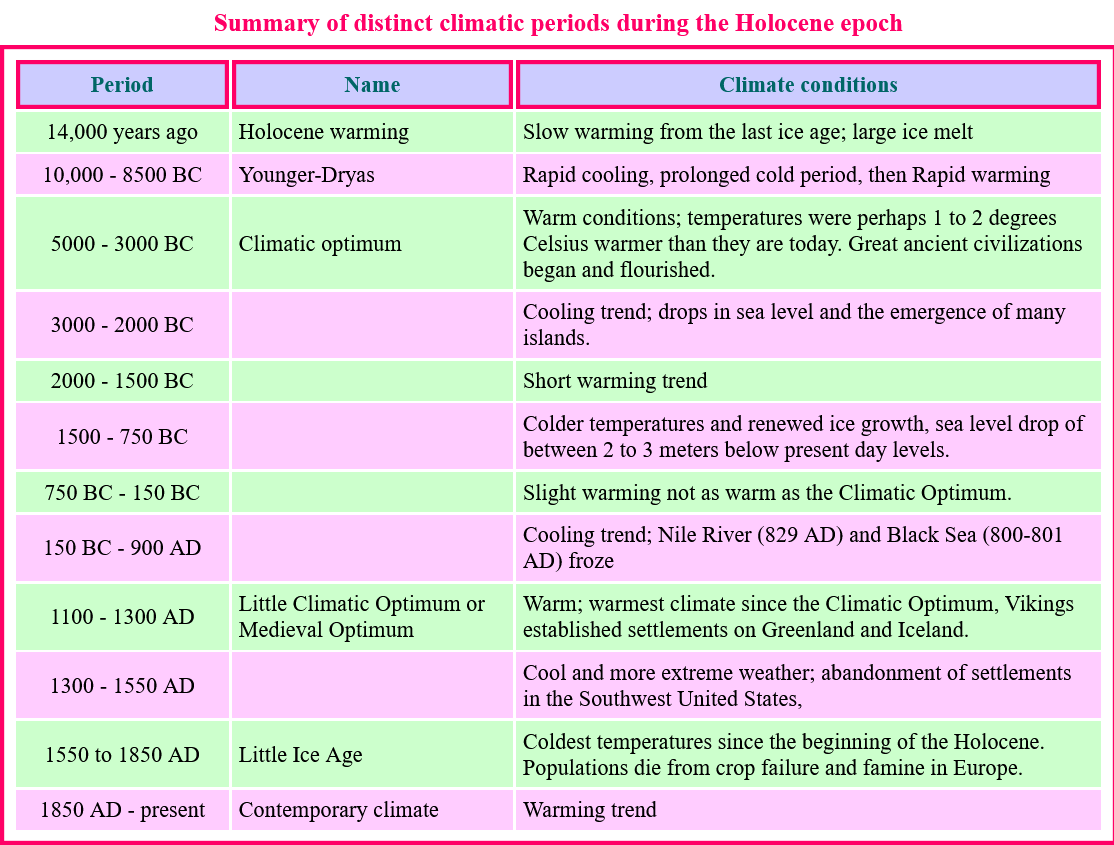
http://www.atmo.arizona.edu/students/courselinks/fall10/atmo336/lectures/sec5/holocene.html
By “warmer than today” it means warmer than pre-industrial. And it might not be that much warmer, that 1-2 C is contested.
So it may already be warmer than it was in the Holocene optimum.
With that background, the current warming could well help SAVE the coral reefs long term once they adapt.
It says that the corals are unlikely to recover NATURALLY to even the pre-2023 levels. The reefs in the north where many more survived are unlikely to NATURALLY colonize the reefs to the south because the prevailing currents are south to north.
QUOTE STARTS
Natural recovery of Florida’s Acropora [elkhorn or staghorn] populations to the pre-1980s levels, the 1996 baseline (when sustained monitoring was established), or even the pre-2023 abundance levels is unlikely.
The remnant A. palmata that survived the 2023 bleaching event are primarily small colonies located on a few reefs and remain vulnerable to disease, predation, storm damage, and future bleaching events. These colonies are unlikely to recover to a functional or reproductive size and may perish without intervention.
...
Because of northerly current trajectories, the surviving corals, which are mainly located in the far northern FCR, are unlikely to serve as sources of larvae to the FKRT
The pessimistic conclusions are based on annual bleaching every year which only happens on emissions too high to be possible any more
It then says that as we approach annual bleaching in 15 to 20 years it will be harder to save the corals.
How often the bleaching happens depends on how fast the ocean is warming. It only increases if we have increasing CO2 emissions. But our emissions are close to peaking and may fall rapidly soon. China’s emissions have likely already peaked
India’s emissions will peak in the 2030s and most other major emitters have falling emissions already.
So long as we keep to the 1.5 C path, the rate of warming will decline rapidly in the 2030s and 2040s. Even if we stay on our current 1.7 C path then the rate of warming will fall significantly in the 2030s and 2040s.
The annual bleaching is for the now impossible “Businesss as usual” which actually requires a huge increase in the most CO2 intensive fuel, coal, through to the end of the century which is impossible.
QUOTE STARTS
If marine heat waves with extreme heat anomalies become common, more extirpation events are likely to occur before the threat of annual severe bleaching is realized in 15 to 20 years. Future research is necessary to increase the temporal resolution of marine heat wave forecasts to include prediction of extreme thermal anomalies on daily-to-weekly timescales and to better understand the impacts of acute heat stress on coral reef and tropical taxa beyond reef-building corals.
Aggressive interventions, such as introduction of heat-tolerant genotypes and genetic diversity from outside Florida, as well as algal symbiont manipulation, might be the only means to maintain any Acropora populations in Florida (50). Future restoration efforts that repeat what was done in the past are likely to result only in further losses. Restoration success, however, will likely be limited to localized areas and ultimately depend on the return time and severity of future bleaching events. Gene banking of the survivors and live biorepositories could be the only way to preserve the existing genetic richness of the acroporid corals that still remain in Florida and the Caribbean.
If we stay well below 2 C the conclusions of the paper don’t apply - on low emissions the most difficult time for corals is now, not the 2040s
However if we stay within 2 C then all that doesn’t apply, this would be the most difficult period of all for coral restoration and over the next decade the corals will find it far easier to adapt.
The paper has almost nothing about restoration efforts after 2023 or the successes that I cover in my substack which are sourced to reliable sources including the Coral Reef Restoration Foundation itself.
It talks about how restoration efforts were effective before the 2023 bleaching event - but doesn’t talk at all about the successes after the bleaching event.
Also they don’t explain that these are fast growing corals with the staghorn able to reach maturity in 3 to 5 years and the elkhorn in 10 to 12 years.
It seems very one sided.
On the potential for the future it says
QUOTE If marine heat waves with extreme heat anomalies become common, more extirpation events are likely to occur before the threat of annual severe bleaching is realized in 15 to 20 years.
This I think is based on the now impossible RCP 8.5. The 2.6 C RCP 4.5 has much less bleaching - depending on the reef.
If countries keep to their pledges, and most of the big emitters equal or exceed them, then we are already on track for 1.7 C by the IEA and the triple renewables pledge keeps 1.5 C in view.
So we are not likely to get annual severe bleaching.
Possibly partly based on common assumption that focusing on negatives boosts action on climate change - in reality the ideal ratio is 3 positive framings to 1 climate threat to boost engagement
I think this may be partly based on the idea that focusing only on the negatives increases engagement when in reality, psychologists tell us that presenting at least 3 positive framings for each negative framing increases engagement. The paper has NO positive framing.
As we saw earlier in this blog post, the annual reports are full of their successes.
There is a big disconnect.
Hopefully this helps counterbalance that by adding some positive framing.
BLOG: How to motivate your self, and others to act on climate change, biodiversity or anything else
— tips from psychology
— e.g. for maximum engagement present 3 positive or supporting framings for each climate threat
You can read it here:
https://debunkingdoomsday.quora.com/How-to-motivate-your-self-and-others-to-act-on-climate-change-biodiversity-or-anything-else-tips-from-psychology
This helps with the mental health of the people I help who get easily scared by such stories - and it may even lead to some of them engaging more in action on corals themselves.
And encourage any who are involved in the work to save corals in what they are doing - it really does work!
Not only that, we have potential in Florida to not only recover the diversity but as the corals adapt to warmer temperatures then Florida may return to a boom in coral reef growth as it did in the Holocene over 3000 years ago.
We do have to reduce our CO2 emissions to do this. The paper is surely correct that if we were following the now impossible path with increasing CO2 emissions every year though to the end of the century and eventually bleaching events every year that the corrals would struggle to keep up long before we reached the 3 C where it becomes impossible for most corals to grow because of the increasing CO2 in the water reducing its alklinity.
See
BLOG: Corals only vanish from oceans well above 3°C
— replaced by sponge reefs not deserts
— already stopped them vanishing
— need to slow down warming to help more
— corals are the only ecosystem that can vanish due to warming
— often did in past
You can read it here:
https://debunkingdoomsday.quora.com/Corals-only-vanish-from-oceans-well-above-3-C-replaced-by-sponge-reefs-not-deserts-already-stopped-them-vanishing
But we are not in that world any more. We are already well on track to well below 2 C and that leads to great hope and a very positive long term prospect for the world’s coral reefs.
On the 1.5 C path SSP1-1.9, corals recover to healthy reef states by 2070 in Maldives, and after the initial losses, branching corals increase rapidly once warming slows down and dominate for up to 1000 years after that
This is a projection from the World Bank in 2024 for Maldive reefs
“Limiting global warming to 1.5°C (SSP1–1.9), will allow coral populations to recover in the second half of the century. Under this scenario, the share of reefs with a high coral cover is expected to increase after a midcentury decline... SSP1-1.9 is the only emission scenario projecting a recovery of healthy reef states by 2070.”
This is a global climate model:
“Carbonate production initially decreases and then partially recovers under the high-mitigation scenarios (SSP1-1.9 and SSP1-2.6) as well as under the overshoot scenario (SSP5-3.4-OS), with most coral reef locations returning to net accreting in 2100... Under high-mitigation scenarios, however, global coral reef carbonate production can recover in the 21st and 22nd centuries and thereafter persist at 50%–90% of historical values, provided that the climate sensitivity is moderate.”
This is a study that finds that on low emissions the fast growing branched corals rapidly grow back - and that this enrichment by branched corals may persist for 1000 years.
As with previous studies, peak environmental stress during the 21st century disproportionately affects fast-growing reef corals in CERES, the model assemblage that is dominated by acroporid corals. After individual mass bleaching events, coral community composition in reefs have been widely observed to shift away from (branching) acroporids and toward slow-growing corals with stress-tolerant life-history strategies ).
CERES predicts that this initial shift in community composition may be rapidly followed by a rebound toward fast-growing reef corals, which lead to the recovery of low-latitude reefs from the end of the 21st century.
Acroporids proliferated during the Pleistocene, possibly due to their rapid growth rate, allowing them to efficiently shift their distribution in response to rapid sea level change. The proliferation of acroporid corals in response to the availability of new habitat is consistent with our model predictions: Once fast-growing corals (primarily acroporids) are able to adapt to a warmer climate, their population size grows rapidly and allows them to dominate the recently depopulated tropical reefs.
This “overcorrection” persists for more than 1000 years in our simulations, more than an order of magnitude longer than the initial decline.
https://www.science.org/doi/10.1126/sciadv.adr2545#
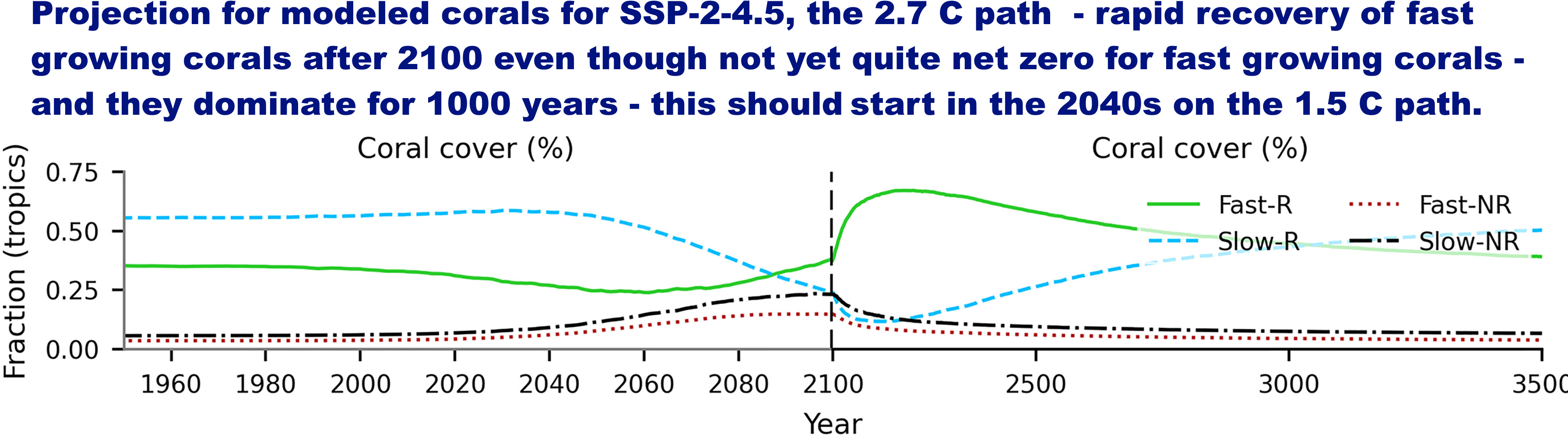
From figure 6 https://www.science.org/doi/10.1126/sciadv.adr2545#
I can’t find ANYTHING that
models corals on a 1.5 C path AND
looks at the effects of coral restoration efforts and the rapid advances in science in the last couple of years that mean even slow growing corals can reach maturity in the wild in 5 years.
Once that is taken into account the recovery curves for the slow growing corals with human help could be similar to the fast growing corals. Especially given the amount of enthusiasm and research and work being done to help the corals globally.
I think once this research is done, that the situation is likely to be far more optimistic than anyone is projecting at present.
To check where we are headed on our current path we need to use the IEA projections and the pledge to triple renewables by 2030 which many countries have already joined. Plus that the top emitters China and India exceed their pledges and the other top emitters roughly equal their pledges historically. Assuming they do the same in the future we are headed for well below 2 C and if we add in the triple renewables pledge the gap is very small and 1.5 C is well within reach.
The main focus in Brazil this year is to increase the pledges to triple renewables by 2030. If that doesn’t fully succeed we can continue narrowing the gap in future COPs.
Most of the research on the future of coral reefs seems to focus on SSP1-2.6 with warming several degrees above 2 C. This is based on pledges before COP26 in Glasgow because that was the cut-off date for the papers for AR6.
The IEA is more accurate than the IPCC on this because it is based on up to date research updated every year and is used by the COPS. Check out also IRENA
See my
This is my research thread with Perplexity AI, it takes a lot of background and digging to find out the details, it starts the thread just summarizing what the mainstream media says.
https://www.perplexity.ai/search/scbd-research-about-how-on-low-C2GDs3WhTHO5Vr_dOdaE.A#0
Insights from the holocene optimum - restoration often focuses on Staghorn - fragile and easily destroyed and never a prominent part of the Florida reefs - Elkhorn protects the reefs from erosion and persists with rapid sea level rise - combined with reskinning massive corals can protect reef structures quickly
This shows how Elkhorn (shown in red) dominates most of the reefs in the Holocene optimu, especially in the Middle Keys - although it was never very common in Dry Tortagus - the reef island to the west of the Florida Keys in the South. Staghorn has always been so rare it is included in the “other” category of species - they say that staghorn made up “~2% of the Holocene reef framework”.
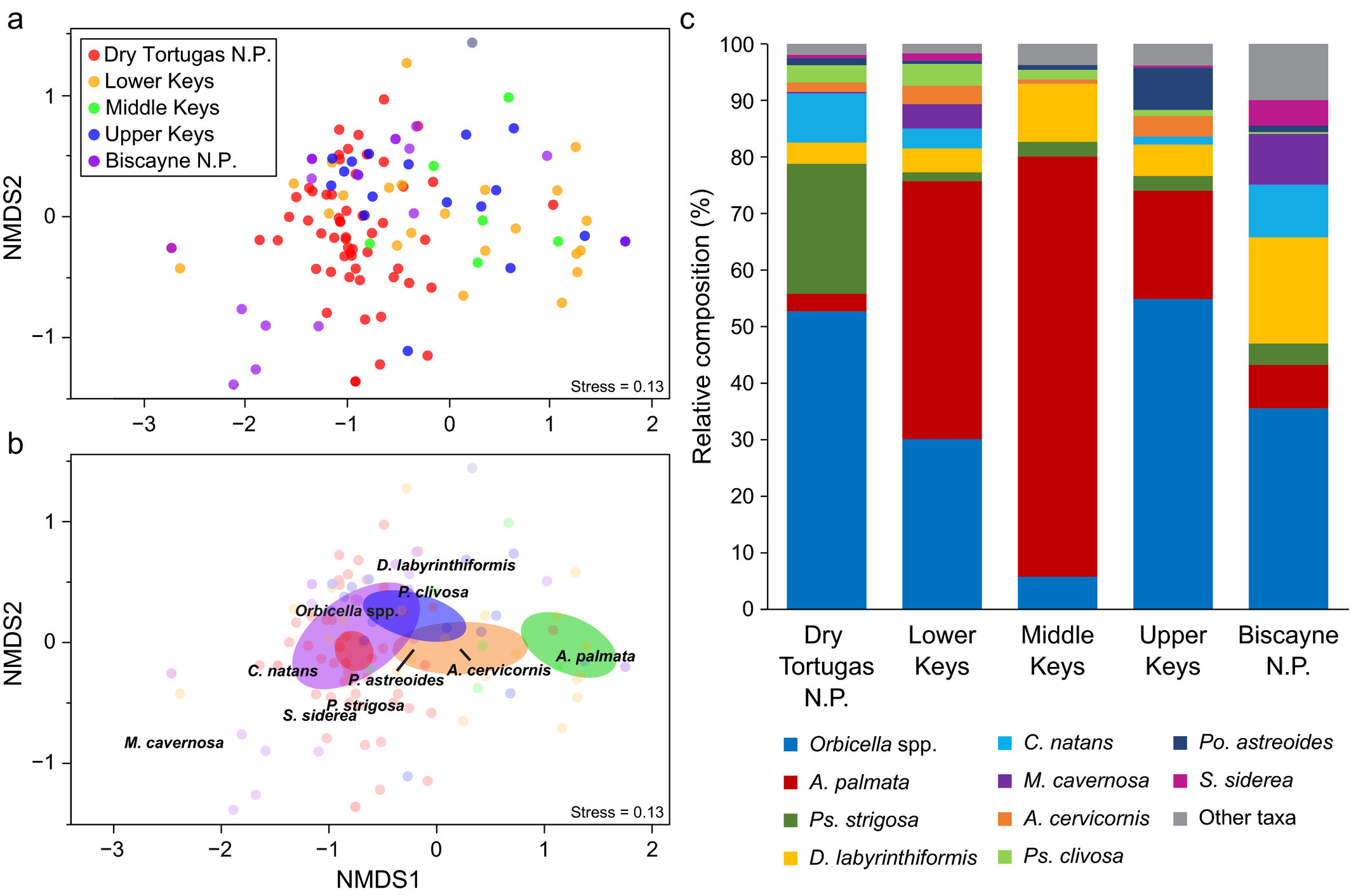
The other dominant species in the Holocene optimum was Orbicella spp., shown in dark blue in that diagram - that’s the same slow growing massive genus that in 2020 spawned successfully 5 years after it was palnting using reskinning and fragmentation (covering old dead corals of a similar species with a skin of fragments of living coral that then fuse with it).
See above:
This shows how the reefs have lost the elkhorns, with about half gone over the period of thosuands of years from the middle holocene, and an even biger loss from 1996 to 2005.
So it’s not a new thing to lose them, it happened already by 2005. But it’s something we can reverse.
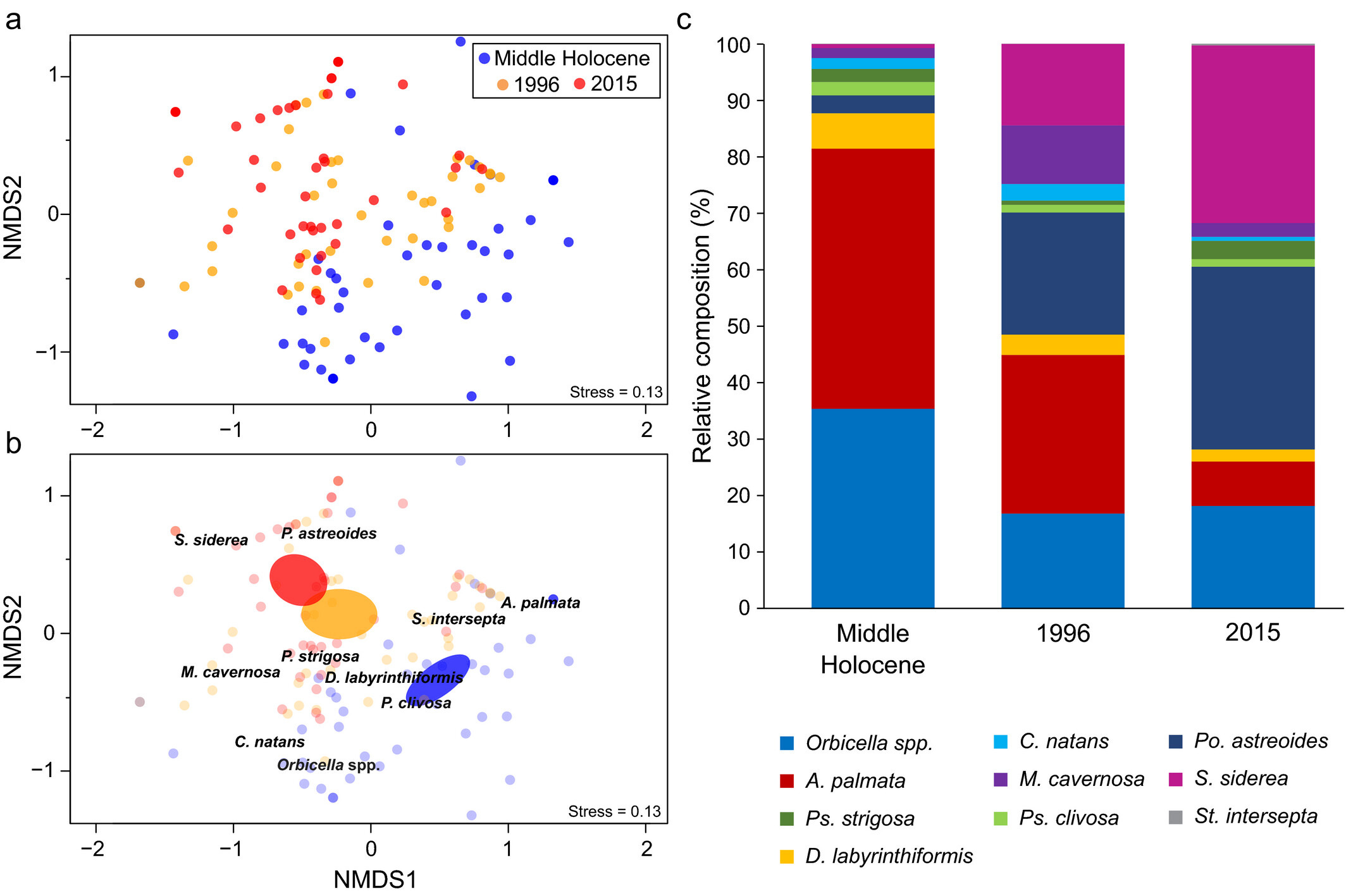
The authors onclude that we should focus reef restoration efforts on the staghorns A. palmataand on the massive coral species Orbicella spp. These would protect the corals from further erosion and help them turn around to growth instead of erosion.
They also expand on the history - how the Florida reefs stopped growing and only just kept up with erosion since 3000 years ago.
First that the reefs have always consisted mostly of A. palmata [elkhorn] and Orbicella spp. except that elkhorn has always been rare in dry Tortugas (only 5% of the reef framework at the same depth where it is very common elsewhere).
QUOTE STARTS
In south Florida, just two taxa, A. palmata [elkhorn] and Orbicella spp., accounted for the majority of reef-building during the Holocene. The remaining reef framework was primarily composed of the massive corals, Ps. strigosa, Ps. clivosa, D. labyrinthiformis, C. natans, and M. cavernosa (cumulative percentage: 96%). Similar reef-coring studies in Buck Island in St. Croix, U.S. Virgin Islands (Hubbard et al. 2005) and the Belize Barrier Reef (Gischler and Hudson 2004) suggested that Holocene reef frameworks in those locations were also dominated by A. palmata and Orbicella spp. The resemblance between the composition of all three Holocene reefs to Pleistocene and to pre-Anthropocene reefs throughout the western Atlantic, supports the conclusion that reefs in this region have, until recently, supported a similar assemblage of reef-building taxa for hundreds of thousands of years (Jackson 1992, Budd and Johnson 1999, Aronson and Precht 2001a; Pandolfi and Jackson 2006, Precht and Miller 2007).
...
For comparison, A. palmata accounted for ~80% of the reef framework deposited at paleodepths shallower than 5 m bMSL in the Middle Keys, but, in the Dry Tortugas it only represented ~5% of the reef framework from that same depth zone. Whereas historical accounts suggest that there may have been larger populations of A. palmata in the Dry Tortugas in the late 1800s (Davis 1982), at present, A. palmata is restricted to a small, relic population near Garden Key (Ruzicka et al. 2010). The paucity of A. palmata in the Holocene reef framework suggests that this species may have never been an important reef builder in the Dry Tortugas.
. https://esajournals.onlinelibrary.wiley.com/doi/10.1002/ecy.2781
Staghorn is somewhat more abundant when the sea level rises faster because with its fast growth it keeps up with sea level rise more easily.
In the warmest period 7,000 years ago the reefs grew rapidly but as it cooled down they reefs mainly just kept pace with erosion without any more growth.
QUOTE STARTS
We did find that A. palmata was somewhat more abundant in our limited records from the early Holocene (i.e., before 8,200 yr BP) when the rates of sea-level rise were most rapid (Khan et al. 2017). This taxon has especially high growth rates, which has allowed shallow-water A. palmata reefs to keep pace with even the most extreme rates of sea-level change during the Holocene (Precht and Aronson 2016) and explains why A. palmata is often dominant during the initiation phase of Holocene reef-building in the Caribbean (e.g., Hubbard et al. 2005)
....
The stability of reef framework composition in south Florida from ~8,000 yr BP until the last several decades is especially remarkable in light of the major changes in reef building that occurred on the FKRT during this period. Using the same core records as the present study, Toth et al. (2018a), demonstrated that although reefs on the FKRT accreted rapidly during the Holocene thermal maximum (HTM) ~7,000 yr BP, as climate cooled during the late Holocene, reef accretion declined dramatically. By 3,000 yr BP, reefs throughout the FKRT were no longer growing on pace with the rate of sea-level rise, making them geologically senescent. Holocene reef accretion in south Florida was modulated by the negative influence of variable water masses from Florida Bay (Marszalek et al. 1977, Ginsburg and Shinn 1994, Precht and Miller 2007) and by the declining rate relative sea-level rise after ~6,000 yr BP (Khan et al. 2017), but Toth et al. (2018a) concluded that climate was most likely the ultimate cause of the region-wide shutdown of reef-building by 3,000 yr BP (Toth et al. 2018a).
. https://esajournals.onlinelibrary.wiley.com/doi/10.1002/ecy.2781
The staghorns are highly sensitive to both high and low temperatures and so are the most likely species to be affected by cooling.
Acroporids would have been the most likely species to be negatively affected by the cooling that occurred after the HTM, as they are highly sensitive to both low and high temperature stress (Precht and Miller 2007); however, although the latitudinal range of Acropora populations in south Florida contracted during the middle Holocene as the climate cooled, resulting in its disappearance from the reefs in southeast Florida located north Biscayne N.P. (Fig. 1; Precht and Aronson 2004), A. palmata was present in all subregions of the FKRT except for the Dry Tortugas N.P. throughout the middle and late Holocene (Appendix S1: Fig. S7; Toth et al. 2018b, 2019).
. https://esajournals.onlinelibrary.wiley.com/doi/10.1002/ecy.2781
In the last 6000 years the environmental changes stopped reefs from expanding but weren’t enough to make significant changes to the species that make up the reefs.
The regional environmental changes during the last ~6,000 yr were sufficient to stall reef growth, but they were apparently not severe enough to cause significant changes to reef assemblages. This result supports the conclusions of Toth et al. (2018a) that reef accretion may be one of the most sensitive processes to environmental disturbance and that, although Florida’s reefs were geologically senescent by ~3,000 yr BP, they maintained most ecological functions until recently. The fact that Florida’s reef assemblages remained relatively stable until the last several decades indicates that conditions associated with recent disturbances must have been fundamentally different than what coral reefs have experienced over the last ~8,000 yr.
. https://esajournals.onlinelibrary.wiley.com/doi/10.1002/ecy.2781
They say it may be unrealistic to expect to easily tip back so the coral reefs start growing in size, but it’s a reasonable benchmark to keep them from more erosion.
They explain that though staghorns are easy to grow and provide valuable short term habitat, they are less useful for long term building because they are more fragile than the elkhorns, break up when they die, and get washed away from the reefs, and are also easily bleached.
QUOTE STARTS
Because accretion has been negligible on the FKRT for at least 3000 yr (Toth et al. 2018a), it may be unrealistic to expect that the balance can be easily be tipped back to a state of net accretion; however, preserving the remaining geological structure of Florida’s reefs, and the valuable ecosystem services it provides, is a reasonable minimum benchmark for successful coral-reef management. One increasingly popular tool for coral-reef management that has the potential to help to mitigate the problem reef erosion is coral restoration (Rinkevich 2008, Lirman and Schopmeyer 2016).
Most coral restoration efforts in the western Atlantic to date have focused on A. cervicornis [staghorn corals], because of its high growth rates and potential for reproduction through fragmentation (Lirman and Schopmeyer 2016, Kuffner et al. 2017). Although this coral can provide valuable habitat in the short-term (Lirman and Schopmeyer 2016), it is highly susceptible to mortality from disease and coral bleaching (Aronson and Precht 2001b, Muller et al. 2018). It also contributes only minimally to reef building in the long-term in most locations (but see Aronson et al. 2004, Wapnick et al. 2004), because its fragile morphology makes it susceptible to post-depositional loss from reef framework (Enos and Perkins 1977, Shinn et al. 1981, 2003). In our cores, A. cervicornis only comprised ~2% of the Holocene reef framework (Appendix S1: Tables S1, S2) and it was absent from Holocene reef cores from Buck Island, St. Croix (Hubbard et al. 2005). Continuing to invest time and resources into restoration of such an ephemeral space occupier may, therefore, not be the best means for achieving long-term management goals, particularly in places where shoreline protection from storms is a desirable ecosystem service.
Instead, we suggest shifting the focus of restoration programs to more robust, reef-building species, such as A. palmata and Orbicella spp., which produce reef structure that persists for centuries to millennia after the corals die. Fortunately, several countries in the western Atlantic have recently initiated successful A. palmata restoration programs (Lirman and Schopmeyer 2016). At the same time, novel methods for jump-starting the restoration of Orbicella spp. and other massive taxa are gaining traction (i.e., microfragmenting; Forsman et al. 2015, Page et al. 2018). In particular, the concept of “reskinning” the surface of large, dead, coral colonies through the fusion of coral microfragments (Forsman et al. 2015), provides a potential mechanism for rapidly restoring a veneer of living coral tissue that could protect the reef framework from erosion (Kuffner and Toth 2016). There remain a number of important challenges when it comes to coral restoration, including questions of how, where, and when to outplant corals to maximize growth and survival (Lirman and Schopmeyer 2016, Kuffner et al. 2017, Guest et al. 2018, Page et al. 2018) and how to scale restoration to a level at which it will have a significant impact on reef ecology and function (Rinkevich 2008, Ladd et al. 2019); however, using the geological foundations of western Atlantic reefs to guide what species should be restored is a critical first step in optimizing the outcomes of coral-reef management.
. https://esajournals.onlinelibrary.wiley.com/doi/10.1002/ecy.2781
However since their paper, some reefs have shown net growth so it may be possible to be more ambitious - and from their account of the history - it’s clear that historically when the reefs were at their warmest that’s when they started to grow and expand.
Also as we saw in the last section, in 2019 there seemed little chance of staying well below 2 C to many researchers. Now it is realistic even to stay within 1.5 C with future pledges.
Then there have been extraordinary efforts to restore and protect corals. Given what we can do and what we are doing then the future prospects may be well beyond what seemed possible in 2019.
Global effort to restore and protect corals world-wide
Also - the efforts in Florida are only part of a global effort. There are major efforts similarly in Australia, Hawaii, India, the Phillipines, Red Sea, Carribean etc.
I got Perplexity AI to compile this list for me using my SCBD template
Great Barrier Reef (Australia):
Annual Summary Report of Coral Reef Condition 2024/25 – Australian Institute of Marine Science
Summary: Documents substantial coral mortality from 2024 mass bleaching event affecting the entire GBR, with regional coral cover declining 14-30%. Notes that despite losses, GBR retains higher coral cover than many reefs globally and emphasizes the need for both emissions reductions and active restoration/adaptation interventions.
Quote: “The GBR currently retains higher coral cover than many reefs globally; however, mass coral bleaching events are now occurring with increasing frequency, while recovery periods are decreasing both at the scale of individual reef systems like the GBR and at the scale of reefs globally.”
Bias/credibility: Australian Institute of Marine Science, high credibility, government-affiliated scientific monitoring body, peer-reviewed methodology, authoritative source on GBR health.
Date: 2024-01-31 (covers 2024-2025 monitoring period)
URL: https://www.aims.gov.au/monitoring-great-barrier-reef/gbr-condition-summary-2024-25
Reef Restoration and Adaptation Program: Home – RRAP
Summary: Describes the world’s largest coral reef restoration and adaptation program, centralized on the GBR, with partners including Australian Institute of Marine Science, CSIRO, and multiple universities. Emphasizes that emissions reductions alone are insufficient and restoration solutions deployable within 10 years are critical.
Quote: “The Reef Restoration and Adaptation Program (RRAP) is a global leader in coral reef restoration and adaptation research and solution deployment... the world’s largest effort to help a significant ecosystem survive climate change.”
Bias/credibility: High credibility, Australian government-funded consortium of leading research institutions, transparent partnership structure.
Date: 2024-07-30
URL:
https://gbrrestoration.org
A New Lifeline for the World’s Coral Reefs | Theresa Fyffe – TED (YouTube)
Summary: TED talk by Great Barrier Reef Foundation leader describing targeted large-scale restoration using breakthrough science, automated coral breeding producing millions of baby corals, heat-tolerance enhancement, and precision deployment on highly connected reefs. States restoring 3% of reefs can drive recovery of 50% of ecosystem.
Quote: “We’ve made more advancements in the last five years than the previous 50. Using an automated process, we can now produce millions of baby corals, not just thousands. We can naturally increase the heat tolerance of these corals so they are better adapted to warming oceans.”
Bias/credibility: TED, high credibility platform, Theresa Fyffe is managing director of Great Barrier Reef Foundation, optimistic framing but science-based.
Date: 2025-06-07
URL:
Planting corals to restore the Great Barrier Reef – Garnier (YouTube)
Summary: Corporate-partnership video documenting Garnier’s collaboration with Great Barrier Reef Foundation using coral IVF restoration technique. Details collection of coral spawn, rearing millions of baby corals, and dispersing 700,000 baby corals in 2024 following 500,000 in previous year.
Quote: “Last year we planted 500,000 corals on affected areas of the Great Barrier Reef and this year we’re taking that to the next level by dispersing 700,000 baby corals.”
Bias/credibility: Corporate-sponsored content (Garnier), medium-high credibility, genuine partnership with reputable foundation but promotional framing.
Date: 2024-10-10
URL:
Reef health update | July 2025 – Great Barrier Reef Marine Park Authority (YouTube)
Summary: Official July 2025 monitoring update from GBR management authority reporting on 388 reef health surveys across 44 reefs, providing current status information.
Quote: “Our teams of surveyors conducted 388 reef health and impact surveys last the course of the last month. That was information coming from 44 reefs.”
Bias/credibility: Great Barrier Reef Marine Park Authority, very high credibility, official government monitoring body.
Date: 2025-07-30
URL:
Hawaii:
MASSIVE CORAL RECOVERY PROJECT COMPLETE ON HAWAI’I ISLAND – Hawaii Governor’s Office
Summary: Describes successful removal and relocation of 11 years of coral growth from decommissioned fish farm structure by DLNR Division of Aquatic Resources, The Nature Conservancy, and Arizona State University, providing hundreds of coral colonies for restoration.
Quote: “A collaboration of conservation divers has successfully removed and relocated nearly 11 years worth of coral growth from a decommissioned offshore fish farm pipe ring... The amount of time and effort and money that it would take to grow eleven years’ worth of coral that’s on these offshore pens, is huge. Any amount of coral that we can save from these pens today, is so valuable.”
Bias/credibility: Hawaii State Government official press release, high credibility, government source with conservation partners.
Date: 2024-11-17
URL: https://governor.hawaii.gov/newsroom/massive-coral-recovery-project-complete-on-hawaii-island/
New approach to restore coral reefs on mass scale kicks off in Hawaii – Mongabay
Summary: Details the ʻĀkoʻakoʻa program restoring 193 km of reef along Hawaii Island’s west coast using selective breeding of heat-tolerant corals, genetic diversity enhancement, and community engagement. Notes optimism compared to Florida due to starting from healthier baseline.
Quote: “In Florida, we started miles behind … in terms of coral health. In Hawai’i, we have a fairly healthy, robust reef. We’re not coming into a scorched earth reef where we have to start from ground zero and rebuild the entire ecosystem. As long as we can augment the populations a little bit by introducing more genetic diversity through reproduction, identifying more resilient genotypes through the experimental testing that we’ll do, we’re going to improve the overall population sustainability.”
Bias/credibility: Mongabay, high credibility environmental news outlet with rigorous editorial standards, well-sourced interviews with scientists.
Date: 2025-10-19
URL: https://news.mongabay.com/2024/06/new-approach-to-restore-coral-reefs-on-mass-scale-kicks-off-in-hawaii/
A Guide to Coral Restoration Projects in Hawai’i 2024 – NOAA
Summary: Comprehensive guide compiling coral restoration efforts across Hawaii including projects by The Nature Conservancy, Kuleana Coral Restoration, DLNR Division of Aquatic Resources, and others. Documents methods, locations, and objectives for Porites lobata restoration and community-based approaches.
Quote: Documents restoration methods for “Porites lobata, a key reef-building species in West Hawaiʻi” with primary research questions examining optimal restoration approaches and long-term community goals.
Bias/credibility: NOAA, very high credibility, U.S. federal government scientific agency, comprehensive documentation.
Date: 2024
URL: https://www.ncei.noaa.gov/data/oceans/coris/library/NOAA/CRCP/NOS/OCM/Projects/31581/NA23NOS4820148/DAR2024_NA23NOS4820148_Guide_Coral_Restoration_Projects_HI.pdf
Innovative Coral Restoration Begins in Hawaiʻi After Ship Grounding – NOAA
Summary: Describes first-time use of rubble stabilization technique in Hawaii coastal waters following 2010 ship grounding, securing loose reef fragments to enable coral recovery after passive restoration failed.
Quote: “Scientists are testing rubble stabilization as a coral restoration technique in the coastal waters of Hawai’i for the first time, with promising results. It involves securing loose, broken parts of the reef to the seafloor so corals have a stable surface to grow.”
Bias/credibility: NOAA, very high credibility, federal government scientific agency.
Date: 2025-01-03
URL: https://www.fisheries.noaa.gov/feature-story/innovative-coral-restoration-begins-hawaii-after-ship-grounding
Community Members Restore Hawaiʻi Coral Reefs – NOAA (YouTube)
Summary: Video highlighting Kuleana Coral Restoration training Native Hawaiians and community members in coral restoration with ~$1 million NOAA support through Bipartisan Infrastructure Law, combining Hawaiian values with western science.
Quote: Video highlights work with “Kuleana Coral Restoration, an organization dedicated to restoring Hawaiʻi’s coral reefs and educating the next generation of coral restoration practitioners” with founder Alika Garcia reconnecting Native Hawaiians to “their oldest ancestor—the coral polyp.”
Bias/credibility: NOAA, very high credibility, federal government agency video documenting funded programs.
Date: 2025-07-20
URL: https://www.fisheries.noaa.gov/video/community-members-restore-hawaii-coral-reefs-and-reconnect-traditional-hawaiian
Coral Reef Restoration Project Underway On Hawaiʻi – The Nature Conservancy (YouTube)
Summary: Community-based coral restoration project at Kahaluʻu Bay by The Nature Conservancy, using corals of opportunity (fragments that would otherwise die), fragmenting them to accelerate growth, and outplanting in arrays for natural fusion into larger colonies.
Quote: “Today we’re at beautiful Kahaluʻu Bay and for the first time ever we are kicking off our Coral restoration project with the community... this entire project to restore the corals has been designed by the community with the nature conservancy so they chose what species they chose the location and the methods.”
Bias/credibility: The Nature Conservancy, high credibility international conservation organization, community partnership model.
Date: 2023-11-01
URL:
Restoring Reefs to Build Resilience – The Nature Conservancy Hawaii
Summary: TNC’s science-based, adaptive, and community-centric restoration approach in Hawaii, piloting restoration at resilient sites with community-selected locations, species, and techniques. Only uses storm-broken corals and replants near recovery location.
Quote: “TNC’s marine scientists are working with federal, state and community partners to develop a gold-standard for science-based, adaptive and community-centric restoration in Hawai’i... We recover and use only those corals that have been broken during recent storms or high swells and would otherwise die.”
Bias/credibility: The Nature Conservancy, high credibility international conservation NGO, emphasis on best practices.
Date: 2024-05-22
URL: https://www.nature.org/en-us/about-us/where-we-work/united-states/hawaii/stories-in-hawaii/coral-reef-restoration-and-repair/
Caribbean:
CoralCarib: Advancing Climate-Resilient Coral Restoration in the Dominican Republic – Caribbean Biodiversity Fund
Summary: Six-year IKI-funded project across Cuba, Dominican Republic, Haiti, and Jamaica focusing on climate refugia restoration. In Dominican Republic, outplanted 2,800 microfragments (8 species) and 293,760 recruits from 3 species including Acropora palmata in late 2024. Opening “Marine Innovation Hub” in 2025 using robotics, AI, and molecular biology.
Quote: “In Bayahibe, FUNDEMAR focused on massively producing assisted-sexual coral recruits... 6,030 substrates with approximately 293,760 recruits from three species: Diploria labyrinthiformis, Acropora palmata and Dendrogyra cylindrus were outplanted in degraded reefs and coral nurseries.”
Bias/credibility: Caribbean Biodiversity Fund, high credibility regional conservation funding body, well-documented partnerships.
Date: 2025-09-29
URL: https://caribbeanbiodiversityfund.org/coral-health-articles/coralcarib-advancing-climate-resilient-coral-restoration-in-the-dominican-republic/
After Mass Bleaching, Caribbean Experts Share Innovative Strategies for Coral Reef Resilience – IKI-CAC
Summary: Caribbean Biodiversity Fund virtual session (May 2025) with 80+ participants sharing post-2024 bleaching restoration strategies including assisted gene flow (AGF) to transport heat-tolerant genotypes across islands and larval propagation for genetic resilience.
Quote: “CLEAR Caribbean stressed the urgency of ‘genetic rescue’ after the devastating 2024 mass bleaching event, which wiped out most elkhorn and staghorn outplants in Saint Lucia and St. Vincent and the Grenadines. Assisted Gene Flow (AGF)—transporting heat-tolerant coral genotypes across islands—was presented as a lifeline for regional reefs.”
Bias/credibility: IKI (International Climate Initiative) funded program, high credibility, international development cooperation.
Date: 2025-09-08
URL: https://iki-cac.org/en/impacts/news/after-mass-bleaching-caribbean-experts-share-innovative-strategies-coral-reef
Caribbean Coral Rescue & Restoration Roadmaps – AGRRA
Summary: AGRRA-MPAConnect 3-year partnership expanding coral rescue and restoration in Caribbean MPAs in response to stony coral tissue loss disease and bleaching. Hosted June 2024 workshop with 30 managers/specialists from 16 countries developing site-specific restoration roadmaps.
Quote: “In response to the recent stony coral tissue loss disease outbreak and coral bleaching events in the Caribbean, there is an urgent need to expand the number of coral rescue and restoration efforts and coral species to maintain genetic diversity, reef structure and ecosystem function.”
Bias/credibility: AGRRA (Atlantic and Gulf Rapid Reef Assessment), high credibility long-term Caribbean reef monitoring and conservation network.
Date: 2025-09-24
URL: https://www.agrra.org/restorationroadmaps/
A mixed-restoration approach in the Caribbean – Mars Coral
Summary: Mars Sustainable Solutions partnership with FUNDEMAR in Dominican Republic trialing mixed approach of Reef Stars and coral larvae settlement structures. Deployed 100 Reef Stars across two sites outplanting 1,500+ coral fragments in March 2025, with larval seeding enclosures planned.
Quote: “During this one-week visit, the FUNDEMAR and MSS teams deployed a total of 100 Reef Stars across the chosen coral rubble sites, outplanting over 1,500 coral fragments, taken from local coral nurseries or previously identified parental colonies.”
Bias/credibility: Mars Inc. corporate sustainability program, medium-high credibility, genuine restoration work but corporate framing.
Date: 2023-12-31 (activity in 2025)
URL: https://www.buildingcoral.com/news/a-mixed-restoration-approach-in-the-caribbean
Red Sea / Middle East:
Egypt unveils new $14m plan to protect the Red Sea’s coral reefs – The New Arab
Summary: Egyptian Red Sea Initiative (2024-2030) in collaboration with UNDP, Global Fund for Coral Reefs, and USAID aims to preserve ~99,899 coral reefs. Red Sea corals can handle temperatures up to 6°C above summer average. Success measured by coral health improvements, partnerships, community engagement, and sustainable financing.
Quote: “Alessandro also reveals that corals in the Red Sea can handle temperatures up to 6°C above the highest summer average... The initiative, running from 2024 to 2030, will focus on preserving approximately 99,899 coral reefs along Egypt’s Red Sea.”
Bias/credibility: The New Arab, medium-high credibility regional news outlet, well-sourced with government and UNDP officials.
Date: 2024-10-13
URL: https://www.newarab.com/features/egypt-unveils-new-14m-plan-protect-red-seas-coral-reefs
Egypt’s Red Sea coral reef restoration project achieves breakthrough in Middle East – Egypt Independent
Summary: Nearly decade-long project by Abu Salam Environmental Association and Red Sea Reserves with UNDP-GEF support successfully rehabilitated destroyed coral reefs in Hurghada at three sites using artificial surfaces for natural larval settlement and growth.
Quote: “After nearly a decade of implementing the experiment at three different environmentally damaged sites in the Red Sea... environmental researchers... have announced the success of the project to rehabilitate destroyed coral reefs in Hurghada... The successful natural rehabilitation of coral reefs in this project has opened up new possibilities for environmental researchers.”
Bias/credibility: Egypt Independent, medium credibility Egyptian news source, government-adjacent but documenting real scientific collaboration.
Date: 2024-05-09
URL: https://www.egyptindependent.com/egypts-red-sea-coral-reef-restoration-project-achieves-breakthrough-in-middle-east/
‘World’s largest’ coral-restoration project unveiled in Saudi Arabia – The National News
Summary: King Abdullah University of Science and Technology (KAUST) Coral Restoration Initiative with functioning nursery producing 40,000 corals/year, with larger facility planned for 400,000 corals/year by end of next year on Saudi Arabia’s Red Sea coast.
Quote: “The King Abdullah University of Science and Technology initiative aims to produce hundreds of thousands of corals each year... It is a pilot project for a larger scheme set to be completed by the end of next year, with an annual capacity of 400,000 corals.”
Bias/credibility: The National News (UAE), high credibility Gulf region English-language newspaper.
Date: 2024-04-24
URL: https://www.thenationalnews.com/news/gulf/2024/04/25/worlds-largest-coral-restoration-project-unveiled-in-saudi-arabia/
KAUST Coral Restoration Initiative at Shushah – KAUST
Summary: Large-scale Red Sea restoration program begun 2021, funded by KAUST and NEOM, targeting 100-hectare reef restoration at Shushah Island with goal of outplanting 2 million corals by 2030. Integrates innovative technologies, pioneering propagation and international expertise.
Quote: “The KAUST Coral Restoration Initiative is a large-scale coral reef restoration program in the Red Sea... The initiative will begin with a 100-hectare reef restoration project at Shushah Island... By 2030, 2 million corals will be outplanted to the reef.”
Bias/credibility: KAUST, high credibility Saudi university with world-class marine science program.
Date: 2023-09-05
URL: https://www.kaust.edu.sa/html/reefscape/
WORLD’S LARGEST CORAL RESTORATION PROJECT – NEOM
Summary: KAUST’s first nursery operational on NEOM coast producing 40,000 corals annually, with second facility under construction for 400,000 corals annually, completion anticipated December 2025. Described as largest coral restoration project globally.
Quote: “KAUST’s new coral nursery on the coast of NEOM will produce 40,000 corals annually while a secondary facility with ten times this capacity is built... With construction quickly progressing, the project is anticipated to reach completion by December 2025.”
Bias/credibility: NEOM, medium-high credibility Saudi government development project, promotional framing but documenting real scientific partnership.
Date: 2025-03-15
URL: https://www.neom.com/en-us/newsroom/worlds-largest-coral-restoration-project
Indonesia & Southeast Asia:
Climate-Smart Coral Reef Restoration Planning Workshop – Indonesia, 2025 – Reef Resilience Network
Summary: March 2025 workshop in Papua region co-hosted by Reef Resilience Network and YKAN with 22 participants from national/regional agencies, NGOs, and academia. Focused on climate-smart restoration planning using thermal tolerance data and resilience principles.
Quote: “The goal of the workshop was to support the development of coral reef restoration projects that are embedded in the principles of resilience and provide technical support for using coral thermal data.”
Bias/credibility: The Nature Conservancy’s Reef Resilience Network, high credibility international conservation network.
Date: 2024-12-31 (March 2025 workshop)
URL: https://reefresilience.org/climate-smart-coral-reef-restoration-planning-workshop-indonesia-2025/
IUCN’s upcoming support in Indonesia’s effective marine conservation through the Coral Bond initiative – IUCN
Summary: Coral Bond innovative financing mechanism (2025-2030) mobilizing private capital for coral conservation in Indonesian MPAs with outcomes-based payments tied to measurable targets like coral reef fish biomass. Builds on World Bank LAUTRA project with performance-based approach.
Quote: “The Coral Bond represents a groundbreaking financial instrument designed to mobilise private capital to conserve coral reef ecosystems within marine protected areas (MPAs) in Indonesia... returns to investors are directly tied to the achievement of specific, measurable conservation outcomes.”
Bias/credibility: IUCN (International Union for Conservation of Nature), very high credibility global conservation authority.
Date: 2024-09-01 (project starts 2025)
URL: https://iucn.org/blog/202409/bridging-global-and-local-efforts-iucns-upcoming-support-indonesias-effective-marine
Coral reef insurance project in Indonesia passes milestone with issuance of critical regulation – UNDP IRFF
Summary: UNDP Insurance & Risk Finance Facility collaborating with Swiss Re and Indonesian government to develop parametric reef insurance for Gili Matra Islands enabling post-disaster coral repair for coastal communities heavily reliant on tourism and fishing.
Quote: “UNDP’s Insurance & Risk Finance Facility (IRFF) is collaborating with Swiss Re, in partnership with the Indonesian government and the insurance industry, to develop a long-term insurance solution for coral reef protection and restoration in Indonesia’s Gili Matra Islands... By enabling the repair of coral reef structures in post-disaster scenarios, the parametric reef insurance solution will allow for quicker recovery.”
Bias/credibility: UNDP, very high credibility UN development agency, innovative finance mechanism.
Date: 2025-06-10
URL: https://irff.undp.org/news/coral-reef-insurance-project-indonesia-passes-milestone-issuance-critical-regulation
Philippines:
UP MSI to establish PH’s first coral cryobank facility for coral restoration – UP Marine Science Institute
Summary: University of Philippines Marine Science Institute establishing first Philippine coral larvae cryobank as part of regional Coral Triangle network with Taiwan, Indonesia, Malaysia, and Thailand, supported by CORDAP. Project launched December 2024 targeting Pocilloporid corals.
Quote: “The UP Marine Science Institute (MSI) is set to establish the country’s first coral larvae cryobank facility to boost coral restoration in the Philippines... ‘It’s not just about preserving corals today, it’s about building a foundation for future research and reef restoration that can benefit generations to come,’ said Dr. Maria Vanessa Baria-Rodriguez.”
Bias/credibility: University of Philippines, high credibility national university research institute, regional scientific collaboration.
Date: 2025-08-06
URL: https://msi.upd.edu.ph/up-msi-to-establish-phs-first-coral-cryobank-facility-for-coral-restoration/
Their fate, their future: Community conservation of Palawan – Oceanographic Magazine
Summary: Sulubaaï Environmental Foundation’s community-led marine conservation in Palawan celebrating sixth MPA (120-hectare Debangan Island) designated at UNOC3 in Nice. Participatory model gives local fishers voice in decision-making, with 76.6% survival rate and 70.9% attachment rate for coral restoration in first year. Emphasis on local stewardship and knowledge.
Quote: “We don’t come in with a pre-made plan. We start with conversations,” says Laure Thierry de Ville d’Avray, marine biologist and project manager at Sulubaai. “The knowledge held by local communities is invaluable, they are the ocean’s true stewards.”
Bias/credibility: Oceanographic Magazine, high credibility UK-based marine conservation publication, well-researched feature journalism.
Date: 2025-08-20
URL: https://oceanographicmagazine.com/features/their-fate-their-future-community-led-conservation-of-palawan/
Regenerating the ocean by listening to the sea and locals who call it home – PhilSTAR L!fe
Summary: Sulubaaï Foundation’s Shark Fin Bay MPA Network awarded gold-level Blue Park Award at 3rd UN Ocean Conference June 2025. Network expanded from 4.5-hectare Pangatalan Island (2016) to five MPAs spanning 9 square kilometers by 2025. Demonstrates how Filipino communities can lead globally-recognized conservation when respected and included. Results surpassed unprotected sites with increases in fish density, biomass, and size.
Quote: “While the award is a source of pride and motivation, it’s not just about Sulubaaï,” says Conservation Officer Kim Mamburam. “It proves how local Filipino communities, when respected, collaborated with, and truly included, can lead effective and globally-recognized conservation efforts.”
Bias/credibility: PhilSTAR Life, medium-high credibility, major Philippine news outlet, well-documented local reporting.
Date: 2025-07-27
URL: https://philstarlife.com/news-and-views/210970-regenerating-ocean-listening-sea-locals-who-call-home
DOST to set artificial reefs in Tagum City to boost marine biodiversity – DOST Philippines
Summary: Department of Science and Technology Region 11 partnering with Tagum City to install 100 artificial coral reefs (ACRs) in coastal waters. Initiative addresses coral degradation from climate change, illegal fishing, and coastal development. MOA signed August 2025 between Mayor Rey T. Uy and DOST. Falls under Community Empowerment through Science and Technology (CEST) and Grassroots Innovation for Inclusive Development (GRIND) programs.
Quote: “This project is a practical example of how science and technology can support local efforts to protect marine ecosystems,” said DOST 11 Regional Director Dr. Anthony C. Sales.
Bias/credibility: DOST Philippines, high credibility, official Philippine government science agency.
Date: 2025-08-28
URL: https://www.dost.gov.ph/knowledge-resources/news/86-2025-news/4152-dost-to-set-artificial-reefs-in-tagum-city-to-boost-marine-biodiversity.html
Philippines to Launch First Coral Larvae Cryobank – Biobanking.com
Summary: UP Marine Science Institute establishing country’s first coral larvae cryobank at Bolinao Marine Laboratory as part of regional Coral Triangle cryorepository network. Initial focus on fast-growing pocilloporid corals to accelerate reef recovery. Project launched December 2024, partnership with Taiwan, Indonesia, Malaysia, and Thailand research institutions.
Quote: “It’s not just about preserving corals today, it’s about building a foundation for future research and reef restoration that can benefit generations to come,” said Dr. Maria Vanessa Baria-Rodriguez.
Bias/credibility: Biobanking.com, medium-high credibility, specialized biotechnology news site.
Date: 2025-08-18
URL: https://www.biobanking.com/philippines-to-launch-first-coral-larvae-cryobank-to-boost-reef-restoration/
Coral reef restoration in the Philippines – UTS
Summary: University of Technology Sydney Climate Society and Environment Research Centre project (2021-2025) improving institutional effectiveness of coral reef restoration in Philippines. Supporting four municipal governments to develop coastal resource management plans including coral restoration, and national agencies to develop new policy. Led by Prof. Michael Fabinyi with Philippine partners including Dr. Maria Vanessa Baria-Rodriguez.
Quote: “This project aims to improve the institutional effectiveness of coral reef restoration in the Philippines, by understanding political-economic influences on governance at multiple scales and applying lessons learned through action research.”
Bias/credibility: UTS, very high credibility, major Australian university research project with extensive Philippine partnerships.
Date: 2025-09-30
URL: https://www.uts.edu.au/case-studies/coral-reef-restoration-in-the-philippines
GFCR in the Philippines: Strengthening Reef Resilience – Global Fund for Coral Reefs
Summary: Global Fund for Coral Reefs Philippine program ‘Mamuhunan sa mga Marine Protected Areas’ approved at fourth Executive Board meeting, issuing over $10 million. Program led by Blue Finance targets Verde Island Passage, Calamian Island, and Tañon Strait MPA networks (80 MPAs, 30,000+ hectares). Aims to improve resilience, achieve 50%+ increase in reef fish biomass, and create 1,700+ sustainable livelihoods emphasizing women and marginalized groups.
Quote: “In a context of budget restrictions and COVID-19 recovery, blended finance solutions to generate critical finance for MPAs are a vital step toward marine conservation and natural resource management... generated investment revenues will allow us to sustain the financing of our MPA teams and community rangers (Bantay Dagats).” – Nicolas Pascal, Executive Director, Blue Finance
Bias/credibility: Global Fund for Coral Reefs, high credibility, UN-affiliated international funding mechanism.
Date: 2020-09-08 (program approval 2021)
URL: https://globalfundcoralreefs.org/reef-plus/news/gfcr-in-the-philippines-strengthening-reef-resilience/
Apo Island: The Philippines’ Marine Conservation Success – Divernet
Summary: Apo Island represents decades-long marine conservation success story where locals now enjoy sustainable fishing, tourism income, and healthy reef ecosystems, proving conservation and livelihoods can coexist. Community-managed marine sanctuary established through local initiative.
Quote: “Locals now enjoy sustainable fishing, tourism income, and healthy reef ecosystems, proving conservation and livelihoods can coexist.”
Bias/credibility: Divernet, medium-high credibility, UK-based dive magazine with conservation focus.
Date: Not specified (2025 access)
URL: https://divernet.com/world-dives/asia/apo-island-marine-conservation-success/
YouTube Videos:
Coast Guard Champions Reef Restoration Mission in Palawan – Bilyonaryo News Channel (YouTube)
Summary: Philippine Coast Guard leading successful coral reef rehabilitation mission at Pag-asa Island in Kalayaan Island Group, Palawan as part of marine environmental protection efforts. Features interview with Commodore May Marfil, PCG Deputy Chief of Coast Guard Staff for Marine Environmental Protection. 8-minute segment from morning news program.
Quote: “The Philippine Coast Guard is stepping up its marine environmental protection efforts, recently leading a successful coral reef rehabilitation mission at Pag-asa Island in the Kalayaan Island Group, Palawan.”
Bias/credibility: Bilyonaryo News Channel (BNC), medium-high credibility, Philippine free-to-air news network, official government partnership coverage.
Date: 2025-06-19
URL:
Saving Reefs, One Dive at a Time – Unico Conservation Foundation (YouTube)
Summary: 2-minute 43-second video highlighting Saving Philippine Reefs Expedition, one of world’s longest-running coral reef conservation expeditions in Coral Triangle. Led by Coastal Conservation and Education Foundation with Unico Conservation Foundation support. Expedition brings marine scientists and divers to monitor and protect reef systems including pristine MPAs of Siquijor, collecting data to shape marine policy and safeguard biodiversity. Mentions over 2,000 fish species and 500 coral species comprising nearly 8% of world’s total coral reefs.
Quote: “The Philippines is a nation of over 7,000 islands, home to some of the richest marine life on Earth, with over 2,000 species of fish and over 500 species of corals. These corals make up nearly 8% of the world’s total coral reefs.”
Bias/credibility: Unico Conservation Foundation, high credibility, Australian conservation NGO with decade+ Philippines engagement.
Date: 2025-08-16
URL:
Philippines Launches Marine Reserve: Ocean Species Get New Home – mynews.studio (YouTube)
Summary: 5-minute 57-second news video covering August 2025 declaration of Bag Marine Protected Area in Siquijor Province, spanning almost 150 hectares, largest MPA in Siquijor. Established after 18-year effort led by Bag fisherfolk association working with local officials, scientists, and NGOs. Reports success with sea turtles and sharks now moving freely in once-depleted area. Process driven by community rather than top-down approach.
Quote: “Along a stretch of Philippine coastline that was once depleted by over fishing, sea turtles and sharks now move freely. So, what actually changed after nearly two decades of effort?... The difference is both in its size and the way it was established... the process was driven by the BAG fisherfolk association. For 18 years, they led the push for protection.”
Bias/credibility: mynews.studio, medium credibility, AI-assisted news aggregation/synthesis service, information sourced from legitimate conservation announcements.
Date: 2025-08-24
URL:
Palau:
Web Pages:
PICRC Concludes Coral Spawning Training to Strengthen Reef Restoration Capacity – Palau International Coral Reef Center
Summary: Two-month intensive coral spawning training (March-April 2025) led by Dr. Adriana Humanes, expert in coral reproduction. Program brought diverse participants from Palau and region, training on coral spawning techniques, gamete collection, water quality control, genetic diversity, and controlled crosses for climate resilience. Training used PICRC’s seven-year-old coral nursery providing hands-on experience with long-term restoration infrastructure. Participants expressed motivation to lead future reef restoration efforts.
Quote: “This program is a significant step forward in building the local capacity needed to safeguard our reefs. By investing in the next generation of coral restoration practitioners, we are ensuring that Palau and the region are better equipped to face the impacts of climate change with sustainable, science-based solutions,” said Roxanne Siual Blesam, PICRC CEO.
Bias/credibility: PICRC, very high credibility, Palau’s leading coral reef research institution, international scientific collaboration.
Date: 2025-05-14
URL: https://picrc.org/picrc-concludes-coral-spawning-training-to-strengthen-reef-restoration-capacity/
Palau’s Network of Marine Reserves Shows Promise for Coral Reef Recovery – Reef Resilience Organization/PIPAP
Summary: Reef Resilience Organization report (July 2025) documents Palau’s coral reef recovery progress over decade following 2015 bleaching event. Credits nation’s forward-thinking Protected Areas Network (PAN) for recovery achievements. Report highlights encouraging trend toward recovery showing effectiveness of marine protection strategy in reef resilience.
Quote: “A new report by the Reef Resilience Organization highlights the encouraging progress of Palau’s coral reefs towards recovery, a decade after a major bleaching event. This positive trend is credited, in part, to the nation’s forward-thinking Protected Areas Network (PAN).”
Bias/credibility: Reef Resilience Organization, high credibility international reef science network, partnership with PIPAP/SPREP.
Date: 2025-07-23
URL: https://pipap.sprep.org/news/palaus-network-marine-reserves-shows-promise-coral-reef-recovery-according-reef-resilience
Workshop on Building Capacity for Climate-Smart Adaptive Reef Management in Palau – Newcastle University Coralassist Lab
Summary: Five-day training workshop (July 14-18, 2025) hosted by PICRC bringing 22 reef stakeholders (state rangers, agency representatives, tourism operators, coral practitioners) to train in coral restoration techniques. International experts from Coralassist Lab (Newcastle University), Coral Nurture Program (Australia), SECORE International, MARS Sustainable Solutions, and Horniman Museum trained participants on Coralclips® reattachment, Mars Stars artificial reef deployment, and adaptive management. Participants gained hands-on skills in preparation for future mass bleaching events. Palau unique advantage: no severe mass bleaching since 1998 provides opportunity for proactive preparation.
Quote: “The week of training was amazing. I learned a lot through the different experts as well as the PICRC employees and I look forward to more,” said Jason Bells, Ngaraard state ranger. “Palau is in a unique position. Its reefs have not experienced severe mass bleaching since 1998, offering a rare opportunity to act proactively and develop the necessary skills and techniques to be ready to respond when the next mass coral bleaching event occurs.”
Bias/credibility: Newcastle University, very high credibility UK research institution, international partnership model, evidence-based training.
Date: 2025-08-21
URL: https://www.ncl.ac.uk/nes/news/news-items/coralassist-palau-workshop/
Restoring Coral Reefs in Palau Using Mineral Accretion Technology – Coralive (YouTube description and partnership)
Summary: Coralive coral restoration project in Koror, Palau (August 2025 video) using Mineral Accretion Technology (MAT) in partnership with Asian Development Bank and Palau Pacific Resort. Project targets degraded reef restoration over 3-year implementation phase followed by handover to local community. Planted 3,500+ coral fragments in nursery within first 3 months, removed 125 crown-of-thorns starfish, cultivated 45 unique species from six genera with 100+ genetic variants. Innovation: using “clam causeway” (recycled clamshells) to create ecological corridors and fish movement corridors between nursery and reef. Establishing spawning hubs with genetically diverse parent colonies to enable natural recruitment during spawning season. Also studying carbon sequestration properties of MAT technology for first time. Community capacity building with full handover planned within 3 years.
Quote: “Our main propagation technique for coral farming is using mineral accretion technology. Now this is a novel but very innovative scientific technique that basically creates an electrolysis underwater which stimulates coral growth and attachment... We are here just to set up the project, train the local staff and build capacity for this kind of work and in 3 years we will hand the whole thing over to be stewarded by the people of Palau.”
Bias/credibility: Coralive, medium-high credibility coral restoration company, partnership with Asian Development Bank (high credibility multilateral development bank), 10-year company experience, commitment to local capacity building and community handover.
Date: 2025-08-07
URL:
PICRC’s 24th Anniversary Theme: Resilient Ocean, Resilient Community – Palau International Coral Reef Center
Summary: PICRC celebrating 24th anniversary (January 23, 2025) with theme emphasizing interconnectedness of healthy ocean ecosystems and Palauan wellbeing. Over past year, research focused on climate change impacts on coral reefs, heat-resilient coral identification, coral bleaching surveys, ocean acidification monitoring, fisheries research, clam aquaculture, mangrove-coral reef interactions, pelagic environment tuna dynamics, and community engagement in reef restoration. Strong emphasis on effective communications and education, linking research findings to community outreach for ocean stewardship. All work directed toward creating “resilient future in face of change.”
Quote: “All the work we do, whether research, outreach, communications, or management recommendations, is for the community, to create a resilient future in the face of change... The ‘Resilient Ocean, Resilient Community’ theme encompasses this goal,” stated PICRC CEO Roxanne Siual Blesam.
Bias/credibility: PICRC, very high credibility, Palau’s leading research and aquarium institution, 24-year track record.
Date: 2024-12-02
URL: https://picrc.org/picrcs-24th-anniversary-theme-resilient-ocean-resilient-community-highlights-palaus-connection-to-the-sea/
Palau National Marine Sanctuary Named a Blue Spark – Marine Conservation Institute/PICRC
Summary: Marine Conservation Institute and PICRC announced Palau National Marine Sanctuary (PNMS) is Blue Spark marine protected area collaboration (November 2023). Blue Spark designation reflects PICRC’s leadership and commitment to effective PNMS implementation, reflecting progress toward prestigious Blue Park Award for conservation excellence. PNMS is one of world’s largest MPAs, protecting 80% of Palau’s Exclusive Economic Zone (475,000+ km²) from all extractive activity. Sanctuary stretches from 24 nautical miles offshore to EEZ edge, protecting unique deep-water geological features and known/undiscovered biodiversity. Palauan name “Euotelel a klingil a debel Belau” reflects historical ocean stewardship connection—”Euotelel” (refuge/sanctuary), “klingil” (all life), “debel Belau” (Palauan relationship to ocean).
Quote: “The Palau National Marine Sanctuary is a huge contribution to conservation for Palau and the world. The core goals of the PNMS have always been the conservation of a beautiful, healthful and resourceful natural environment and the promotion of the national economy. This Blue Sparks designation showcases that we are on track to achieving these goals,” said PNMS Program Manager King Sam.
Bias/credibility: Marine Conservation Institute, very high credibility conservation organization, PICRC partnership, official Blue Spark designation process.
Date: 2023-11-16
URL: https://sevenseasmedia.org/palau-national-marine-sanctuary-named-a-blue-spark-in-growing-network-of-outstanding-marine-protected-areas/
Palau National Marine Sanctuary Project Ends Successfully – PIPAP/SPREP
Summary: Four-year UNDP/Global Environment Facility funded project (2021-2025) supporting PNMS management ($1.8 million total) successfully concluded October 31, 2025. Project enabled Ministry of Justice, Ministry of Agriculture/Fisheries/Environment, and PICRC to advance PNMS strategic objectives through fisheries management, enforcement & surveillance, research and outreach. Project addressed unique challenges of managing large-scale remote MPA (590,000+ km² oceanic area) largely unexplored. Highlights: consultations with 39 local/international experts developing PNMS Science & Monitoring Strategy prioritizing research needs; innovative education/outreach including local artist PNMS song contest, student deep-sea concepts for PICRC calendar, school students creating PNMS videos, constructing remotely operated vehicles for deep-sea exploration.
Quote: “A national project to strengthen management efforts for the Palau National Marine Sanctuary (PNMS) has successfully concluded after four years and $1.8 million in support of fisheries management, enforcement & surveillance, and research and outreach efforts... Project highlights included consultations with 39 local and international experts, managers and partners to develop the PNMS Science & Monitoring Strategy.”
Bias/credibility: PIPAP/SPREP, very high credibility, Pacific Regional Environment Programme partnership, official government implementation report.
Date: 2025-10-31
URL: https://www.pipap.sprep.org/news/project-supporting-palau-national-marine-sanctuary-ends-successfully
GFCR Annual Narrative Report: Micronesia (Palau focus) – Global Fund for Coral Reefs/UNDP
Summary: Comprehensive GFCR program report covering Micronesia region (Palau, Marshall Islands, FSM) 2025 progress. In Palau: coral reef monitoring completed with data ready April 2025; PICRC completed monitoring program design, field work, and submitted invertebrate data with fish/benthic data extraction in progress. $1.5 million CORDAP funding secured for coral restoration across three countries. GFCR establishing heat-tolerance coral testing capacity and on-site restoration work using tested heat-tolerant corals. Climate-smart coral restoration framework completed in Palau to be expanded to FSM/Marshall Islands. Project Finance for Permanence (PFP) exploration with Enduring Earth partnership targeting 100+ million USD for long-term sustainable financing. Broad community support for coral restoration found; Pohnpei state legislature passed resolution requesting genetic rescue initiatives.
Quote: “Based on consultations, we found that there is broad support for exploring coral restoration. In fact, we found that in Pohnpei, the state legislature already passed the resolution asking the...” Climate-smart coral restoration framework identified as key output.
Bias/credibility: GFCR, very high credibility UN-affiliated international financing mechanism, UNDP partnership, official program documentation.
Date: 2025-04-01
URL: https://mptf.undp.org/sites/default/files/documents/2025-04/gfcr_annual_narrative_report_micronesia_final.pdf
Resilience Strategy for the Koror Rock Islands Southern Lagoon – Great Barrier Reef Foundation/Resilient Reefs Initiative
Summary: Resilience Strategy document (2023) from Great Barrier Reef Foundation’s Resilient Reefs Initiative (AUD$14 million global program) launched in Palau May 2021 as partnership between GBRF and four UNESCO World Heritage Sites. Partnership brings reef managers/communities into global network catalyzing resilience solutions. In Palau: Chief Resilience Officer appointed, Resilience Strategy developed through deep inclusive engagement with traditional leaders, community groups experiencing sea level rise, scientists, public sector, broader community. Strategy integrates priorities from local/national planning documents, identifies funding and partnership gaps. Four funded priority projects launched in areas of fisheries management, cultural asset preservation, innovative finance, adaptive management institutionalization. Framework emphasizes community-centered reef management addressing climate change (sea level rise, tropical storms, warming, coral bleaching) through Reef Resilience Framework examining Ecosystem, Community, and Governance dimensions and 12 attributes.
Quote: “The Resilient Reefs Partnership is bringing crucial resources, connections, and technical expertise to the reef management organisations and communities on the frontline of protecting coral reefs and adapting to climate change... This Strategy offers a launch pad for new funders wanting to support impactful work in Palau and an exemplar for other nations in the region,” stated Anna Marsden, Managing Director, Great Barrier Reef Foundation.
Bias/credibility: Great Barrier Reef Foundation, very high credibility international conservation organization, UNESCO partnerships, AUD$14M program scale.
Date: 2023 (Resilience Strategy framework), 2021-2025 (implementation period)
URL: https://www.barrierreef.org/uploads/Resilience-Strategy-for-the-Koror-Rock-Islands-Southern-Lagoon-051023.pdf
YouTube Videos:
Restoring Coral Reefs in Palau | 2025 – Coralive (YouTube)
Summary: 8-minute 40-second professional video (August 2025) documenting Coralive’s coral restoration project in Koror using Mineral Accretion Technology (MAT). Shows electrolysis-based coral growth stimulation on metal structures, innovative “clam causeway” ecological corridors using recycled clamshells, crown-of-thorns starfish culling operations (125 removed in first 3 months), genetic diversity protocols with 100+ variants, spawning hub strategies, and three-year implementation with community handover. Includes detailed explanation of MAT scientific mechanism, footage of underwater structures, trained local staff, and partnership structure with Asian Development Bank and Palau Pacific Resort.
Quote: “Our main propagation technique for coral farming is using mineral accretion technology. Now this is a novel but very innovative scientific technique that basically creates an electrolysis underwater which stimulates coral growth and attachment.”
Bias/credibility: Coralive YouTube channel, medium-high credibility, professional production quality, transparent partnership disclosure, commitment to local capacity building explicitly stated.
Date: 2025-08-07
URL:
Diving Palau 2025: 1. Healthiest Reefs – Pawlik Lab (YouTube)
Summary: 16-minute professional underwater video (June 2025) documenting diving at Ulong Channel and Siaes Corner, followed by tour of coral garden off Orange Beach, Peleliu. Described as “cleanest and healthiest reefs” visited on liveaboard trip. Features 4K video footage of vibrant coral ecosystems, fish diversity, and reef health indicators. Part of 3-part Palau June 2025 series from Pawlik Lab research expedition.
Quote: “These were the cleanest and healthiest reefs that we visited on this liveaboard trip.”
Bias/credibility: Pawlik Lab, high credibility marine science research group, scientific documentation, professional video production.
Date: 2025-06-20
URL:
Diving Palau 2025: 2. Nikko Bay Coral Garden – Pawlik Lab (YouTube)
Summary: 7-minute 39-second underwater video (June 2025) featuring Nikko Bay snorkeling footage showing dense coral garden and giant clams despite warmer, more acidic bay conditions. Highlights exceptional local adaptation of corals to stressful conditions (acidified and warmed waters). References scientific papers on Nikko Bay coral resilience and 1997 comparison footage, demonstrating reef persistence under naturally challenging conditions relevant to understanding coral adaptation in climate change context.
Quote: “Nikko Bay is a beautiful embayment adjacent to the city of Koror. The subtidal shoreline of this bay is densely covered by a garden of reef-building corals and giant clams. This is surprising because Nikko Bay is warmer and more acidic than what would be expected to support healthy coral growth.”
Bias/credibility: Pawlik Lab, high credibility marine science research group, scientific documentation with peer-reviewed references provided.
Date: 2025-06-26
URL:
Secrets of Life Beneath the Coral Reefs – The Radiance of Animals (YouTube)
Summary: 50-minute 36-second immersive educational documentary (October 2025, French language with English subtitles available) blending education, ecology, and ocean conservation. Features 4K underwater cinematography of Palau marine biodiversity including green sea turtles, colorful fish, manta rays, and peaceful sharks. Explores Palau coral reefs as cathedral-like structures harboring ancient creatures, while addressing climate threats: ocean warming, plastic pollution, coral bleaching. Emphasizes biodiversity’s role in planetary balance and connection to future generations.
Quote: “Beneath these clear waters, coral reefs extend like living cathedrals sheltering ancient and invisible creatures united in an endless dance... Palau is an underwater garden in perpetual invention, a living fresco painted by currents, sculpted by light.”
Bias/credibility: The Radiance of Animals, medium-high credibility nature documentary channel, professional production quality, scientific consultation evident.
Date: 2025-10-11
URL:
Palau, An Ocean Inheritance – CEFF 2025 (Eventive/Festival Streaming)
Summary: Feature documentary (May 2025 premiere, festival screening) directed by Skylar Chen and Rayne Sullivan (119 minutes with filmmaker conversation). Immerses viewers in Palau’s islands where cultural heritage, ancient legends, and marine biodiversity converge. Powerful call for ocean justice rooted in Indigenous knowledge and community-led stewardship. Nominated for SDG Films Goal 14: Life Below Water award. Celebrates natural wonders from vibrant coral ecosystems to majestic species while centering Indigenous solutions and community voices.
Quote: “’Palau, An Ocean Inheritance’ immerses viewers in Palau’s incredible islands, where cultural heritage, ancient legends, and marine biodiversity converge, culminating in a powerful call for ocean justice rooted in Indigenous knowledge and community-led stewardship.”
Bias/credibility: CEFF 2025 (California Environmental Film Festival), high credibility film festival platform, official premiere venue, multiple filmmaker awards and nominations.
Date: 2025-05-13 (premiere) / 2025-02-23 (festival screening)
URL: https://watch.eventive.org/ceff2025/play/678949db805eae48a3b8092a
Video - Palau: Nest of Life – PIPAP/PICRC (YouTube)
Summary: Short film produced for PICRC as part of Our Ocean 2022 Conference, featuring Palauans describing environment as “Lukel a Klengar” (nest of life). Interviews with former President Tommy Remengesau Jr., Ann Singeo (Ebiil Society Executive Director), Paramount High Chief Reklai (traditional leader), and others sharing wisdom and insights about large ocean conservation in Palau National Marine Sanctuary context. Emphasizes cultural values and traditional knowledge integration in marine conservation.
Quote: “Palauans describe the environment as ‘Lukel a Klengar’ - the nest of life.”
Bias/credibility: PIPAP/PICRC, very high credibility institutional partnership, official conference film, Indigenous leadership and perspective prioritized.
Date: 2025-10-31 (accessible online)
URL: https://pipap.sprep.org/content/video-palau-nest-life
India:
Two Decades of Coral Restoration in India Show Promising Results – ICRI
Summary: Comprehensive summary of 20-year coral restoration program (2002-2024) in Gulf of Mannar led by Suganthi Devadason Marine Research Institute (SDMRI) and Tamil Nadu Forest Department. Transplanted 51,183 coral fragments (8-12 cm each) representing 20 native species on 5,550 artificial substrates, restoring ~40,000 square meters of degraded reefs. Acropora showed highest success with survival rates up to 79.5% and growth reaching 16.7 cm per year. Restored corals exhibited gametogenic activity (reproductive capacity) similar to wild corals.
Quote: “The branching coral genus Acropora showed the highest success, with survival rates and growth reaching up to 16.7 cm per year... Restored corals have exhibited gametogenic activity similar to wild corals, indicating functional maturity and reproductive viability.”
Bias/credibility: ICRI (International Coral Reef Initiative), very high credibility, UN-affiliated international scientific body, citing peer-reviewed journal publication.
Date: 2025-07-03
URL: https://icriforum.org/coral-restoration-india/
Revival of Reefs in the Gulf of Mannar – Insights on India
Summary: Educational overview of Gulf of Mannar coral restoration success story highlighting causes of degradation, restoration methods using artificial substrates (TARs, PTARs), and measurable outcomes. Documents 51,183 coral fragments transplanted on 5,550 substrates with 55-79% survival rates. Notes coral recruits in TARs increased from 1.23 (2004) to 24.77 (2020), and fish density rose from 14.5 to 310 per 250 square meters between 2006-2020. Led by SDMRI and Tamil Nadu Forest Department since 2002.
Quote: “Coral recruits in TARs rose from 1.23 (2004) to 24.77 (2020). Fish Density rose from 14.5 (2006) to 310 (2020) per 250 m².”
Bias/credibility: Insights on India, high credibility Indian educational platform on current affairs, official UPSC exam preparation resource.
Date: 2025-08-17
URL: https://www.insightsonindia.com/2025/08/18/revival-of-reefs-in-the-gulf-of-mannar/
Long term coral restoration efforts to mitigate anthropogenic and climatic impacts in Gulf of Mannar, India – ScienceDirect
Summary: Peer-reviewed research article (2025) documenting comprehensive coral restoration initiative in Gulf of Mannar over two decades. 51,183 coral fragments with survival rates 55.6-79.5%, Acropora reaching 16.7 cm/year growth. Restoration cost relatively modest at US$112 per square meter over 20 years. Restored corals demonstrated reproductive activity. Ecological monitoring showed marked improvements in reef health at restored sites with increased live coral cover, higher coral fragment density, and greater reef fish abundance vs. unrestored areas.
Quote: “An area of 40,000 square meters of damaged reef has been rehabilitated... The 51,183 transplanted coral fragments witnessed survival rates of 55.6–79.5%. Of the 20 species, Acropora spp. had the highest growth rate (up to 16.7 cm/year).”
Bias/credibility: ScienceDirect, very high credibility peer-reviewed scientific journal database, published research.
Date: 2025-07-27
URL: https://www.sciencedirect.com/science/article/abs/pii/S0301479725023539
Coral Reefs of the Gulf of Mannar, Tamil Nadu, India: Decadal Changes in Status and Management Paradigms – ICRI
Summary: Official report by SDMRI and Tamil Nadu government analyzing two decades of Gulf of Mannar coral reef changes. Documents decline in live coral cover from 37% (2005) to 27.3% (2021), with recovery to 42.9% in 2009 after coral mining cessation, followed by impacts from 2010 and 2016 bleaching events. Reef area decreased from 11,060 hectares (2005) to 6,628 hectares (2021). However, coral species diversity increased from 117 to 132 species. Reports key strategies: coral transplantation, artificial reef deployment, seagrass rehabilitation, and proposed Coral Reef Conservation Action Plan.
Quote: “Live coral cover declined from 37% in 2005 to 27.3% in 2021... Reef areas decreased significantly from 11,060 hectares in 2005 to 6,628 hectares... despite challenges, coral species diversity increased from 117 to 132.”
Bias/credibility: ICRI and Tamil Nadu Government, very high credibility, official government scientific report.
Date: 2025-01-21
URL: https://icriforum.org/indias-coral-reefs-2025/
Coral Crisis: Saving India’s Underwater Rainforests in the Face of Climate Change – The CSR Universe
Summary: Comprehensive overview of India’s coral reef crisis across Andaman/Nicobar Islands (50%+ bleaching), Lakshadweep (90% species at risk, 20-25% decline), and Gulf of Kutch (30% reduction since 2000). Details multiple restoration initiatives: ZSI coral nurseries in Andaman (2,000+ coral fragments, 60-70% survival since 2020); Lakshadweep assisted recovery projects (15% coral cover increase in 2 years pilot); Gulf of Kutch bio-rock technology (5+ hectares restored since 2018). Notes ₹400 crore allocated under National Action Plan on Climate Change, estimated ₹2,000 crore needed annually for scaling.
Quote: “India’s coral reefs support over 5 million people who depend on them for fishing, tourism, and coastal protection... Andaman and Nicobar alone attract nearly 2 million tourists annually, generating an estimated ₹1,200 crore in revenue.”
Bias/credibility: The CSR Universe, medium-high credibility, India’s corporate social responsibility news platform, well-researched overview.
Date: 2025-10-29
URL: https://thecsruniverse.com/articles/coral-crisis-saving-india-s-underwater-rainforests-in-the-face-of-climate-change
Reef islands in need of restoration – Mongabay India
Summary: Mongabay investigation into Gulf of Mannar reef islands’ erosion and restoration efforts. Highlights role of coral reefs as wave barriers reducing erosion. SDMRI experiment on Vaan Island using trapezoidal artificial reefs achieved 62% survival rate 22 months post-transplant, with surviving fragments withstanding mild 2019 and 2020 bleaching events. Documents that Gulf of Mannar already experiences 3.38 mm annual sea level rise, with predictions of submergence of 627-1,284 hectares under 1-2 meter sea level rise scenarios. Emphasizes nature-based solutions over engineered concrete structures.
Quote: “Coral reefs act as a barrier and reduce the velocity of a wave... Without the coral reefs, the height of the wave is increased, and its impact is harsher... The transplanted corals had an average survival rate of 62%, 22 months after being transplanted. ‘Interestingly, the surviving fragments have withstood two mild bleaching events in 2019 and 2020.’”
Bias/credibility: Mongabay India, high credibility conservation journalism outlet, investigative reporting with expert interviews.
Date: 2025-03-16
URL: https://india.mongabay.com/2025/03/reef-islands-in-need-of-restoration/
Lakshadweep’s coral reefs have halved in last 24 years – Down to Earth
Summary: Research-based article documenting 24-year study (1998-2022) by researchers from across India and Spain on Lakshadweep coral decline. Published in Diversity and Distributions (July 17, 2025), study reveals 50% decline in live coral cover (37.2% in 1998 to 19.1% in 2022). Key finding: coral mortality decreased over successive bleaching events but recovery rates also declined. Recovery accelerates only after 6+ years without bleaching. Identifies stress-tolerant genera like Porites replacing heat-sensitive species. Emphasizes need for both global climate action and local management, predictive framework for conservation prioritization.
Quote: “Coral cover in Lakshadweep declined by ~50% over 24 years, from 37.2% in 1998 to 19.1% in 2022... coral recovery accelerates only after 6+ years without bleaching... ‘Ultimately, the global reach of the climate crisis demands responses at both global and local scales.’”
Bias/credibility: Down to Earth, high credibility Indian environmental journalism outlet, peer-reviewed research reporting.
Date: 2025-07-24
URL: https://www.downtoearth.org.in/climate-change/lakshadweeps-coral-reefs-have-halved-in-last-24-years-and-they-need-time-to-recover
Exploring the suitability of corals of opportunity for reef restoration – ScienceDirect
Summary: Peer-reviewed research (2025) on “corals of opportunity” approach in India, testing fragment and nursery cultivation from January 2023-April 2025. Compares species performance with Pocillopora damicornis and Millepora alicornis showing superior performance relative to Acropora branching species. Recommends marine restoration zones with regulated human activities, community-based monitoring programs, and multi-site long-term studies to improve understanding of restoration dynamics under varying stressors.
Quote: “Following transplantation, coral fragments were monitored every six months over a 27-month period (January 2023 to April 2025)... Pocillopora damicornis and Millepora alicornis showing superior performance.”
Bias/credibility: ScienceDirect, very high credibility, peer-reviewed scientific publication.
Date: 2025-04-01 (published 2025)
URL: https://www.sciencedirect.com/science/article/pii/S2772411525000618
YouTube Videos:
Chasing Corals: Reviving the Gulf of Mannar’s Coral Reefs – Culture Craze (YouTube)
Summary: 10-minute 5-second documentary (August 2025) exploring Gulf of Mannar’s 21 coral reef islands in Tamil Nadu. Features SDMRI scientists’ two-decade restoration efforts, innovative techniques using artificial substrates and reef modules. Highlights groundbreaking restoration approach reviving coral populations and restoring biodiversity and fishery potential. Professional production quality documenting scientists diving and monitoring reef restoration outcomes.
Quote: “In Tamil Nadu, a breathtaking coral necklace can be found along the 21 islands that adorn the Gulf of Mannar marine biosphere... a committed group of scientists from the Suganthi Devadasan Marine Research Institute, SDMRI, in Thutakudi, have been diving deep and meticulously investigating the ocean bed for annual surveys over the past two decades.”
Bias/credibility: Culture Craze, medium-high credibility, Indian educational video channel, professional documentary production.
Date: 2025-08-16
URL:
Lakshadweep Coral Cover Reduced by 50% | Coral Reef – Drishti SSC (YouTube)
Summary: 3-minute 55-second educational video (July 2025) from Drishti IAS examining 24-year coral research study in Lakshadweep. Part of “Latest Update Programme” for UPSC exam preparation. Explains 50% decline in coral cover since 1998, impacts of recurring marine heat waves, research methodology by Nature Conservation Foundation, and findings on coral composition changes at three atolls (Agatti, Gadmat, Kavaratti).
Quote: “A 24-year study reveals that coral cover in Lakshadweep has dropped by 50% since 1998, primarily due to recurring marine heatwaves worsened by climate change. The research highlights significant challenges in coral recovery, with a need for extended periods without bleaching to facilitate full regeneration.”
Bias/credibility: Drishti IAS, high credibility, official UPSC exam preparation platform, evidence-based educational content.
Date: 2025-07-24
URL:
Drishti PCS - Gulf of Mannar Coral Conservation – Drishti PCS (YouTube)
Summary: 2-minute 53-second educational video (August 2025) exploring Gulf of Mannar coral conservation efforts. Part of exam preparation curriculum covering challenges faced by region, government support initiatives, and potential impacts on local communities. Features “Chasing Corals” conservation project as prime example of environmental restoration efforts aimed at reducing degradation of natural resources, directly addressing PCS exam relevant topics.
Quote: “In this video, we explore the ongoing efforts to protect coral reefs, highlighting the challenges faced by the Gulf of Mannar region, the government’s role in supporting such initiatives, and the potential impacts on local communities.”
Bias/credibility: Drishti PCS, high credibility, official PCS/state exams preparation platform, exam-focused educational content.
Date: 2025-08-21
URL:
Global:
Protecting Coral Reefs: A Crucial Challenge for the Future – Ocean & Climate Platform
Summary: Overview of global initiatives including Coral Reef Breakthrough aiming to protect 125,000 km² of reefs with $12 billion by 2030 through four key actions: addressing degradation root causes, doubling protected areas, accelerating restoration, and securing financing. Emphasizes community involvement and Marine Protected Areas.
Quote: “Launched during COP15... the Coral Reef Breakthrough aims to protect 125,000 km² of coral reefs with $12 billion in investments by 2030. It proposes four key actions to be implemented globally to safeguard reefs: addressing the root causes of degradation, doubling the protected area coverage, accelerating restoration efforts, and securing sustainable financing.”
Bias/credibility: Ocean & Climate Platform, high credibility international multi-stakeholder platform on ocean-climate issues.
Date: 2024-12-04
URL: https://ocean-climate.org/en/protecting-coral-reefs-a-crucial-challenge-for-the-future/
NEDTalk: NOAA’s Coral Reef Watch and the Fourth Global Coral Bleaching Event (YouTube)
Summary: Dr. Derek Manzello provides October 2024 update on fourth global bleaching event affecting 84% of world’s reefs across 82 countries from January 2023-March 2025, with 74% experiencing heat stress. Caribbean and Florida facing 90-100% mortality in shallow waters. Comprehensive scientific overview.
Quote: “From 1 January 2023 to 30 March 2025, bleaching-level heat stress impacted 84% of the world’s reefs, with 82 countries, territories and economies suffering damage... Many shallow-water corals in Florida, Mexico, and Puerto Rico are facing near-total mortality rates of 90–100%.”
Bias/credibility: NOAA, very high credibility U.S. federal government scientific agency, authoritative global monitoring.
Date: 2024-10-28
URL:
Accelerating Coral Conservation – The Nature Conservancy (YouTube)
Summary: Video describing The Nature Conservancy’s efforts to accelerate pace and scale of coral conservation globally through innovative partnerships.
Quote: Video describes “how The Nature Conservancy and its innovative partners are achieving an ambitious vision to accelerate the pace and scale of coral conservation.”
Bias/credibility: The Nature Conservancy, high credibility international conservation organization.
Date: 2025-04-06
URL:
See
https://www.perplexity.ai/search/i-did-this-debunk-about-the-cl-P1yXxmPdQSumZrocNLVqbw#5
For the template I used see:
Perplexity AI was a pioneer in direct access to the internet so that it’s chatbot can download pages and quote accurately from them but the other major chatbots now do it too and can likely also produce good results with this template.
CONTACT ME VIA ddebunked.org OR EMAIL
You can Direct Message me on Substack - but I check this rarely. Better, email me at support@robertinventor.com
OR contact me at our new forum
https://ddebunked.org
Please do NOT Direct Message me on Facebook any more unless you are already in contact with me.
Sadly Facebook’s algorithm has misidentified my fact-checks as spam. Any human would immediately recognize this as a mistake but recently Facebook changed its appeal process to algorithms all the way up.
So there is no way to appeal. That is why I had to leave Facebook and stop running the group that I had been running for a decade to help scared people and start up this new forum. Stevie-Lee McCarthy is running my old Facebook group instead.
Luckily Facebook didn’t block my access to the people I alread help via private messaging on Facebook but it has stopped me from accepting new contacts or making new contacts. I don’t know if this is permanent but it’s lasted for a month so far. There seems no way to appeal at present.
Because Facebook doesn’t want to alert spammers to methods they cna use to evade detection, its algorithms don’t tell suspected spammers even that they have been blocked in this way and they don’t say why they are blocked or how long the block will last. The accept button just no longer works.
But you can contact me easily at our new forum which is one I built myself using the Flarum free open source software. It is purpose designed for our voluntary fact checking.
https://ddebunked.org
It’s best to use private discussions rather than chat for this:
FOR MORE HELP
To find a debunk see: List of articles in my Debunking Doomsday blog to date See also my Short debunks
Scared and want a story debunked? Post to our Facebook group. Please look over the group rules before posting or commenting as they help the group to run smoothly
Facebook group Doomsday Debunked
Also do join our facebook group if you can help with fact checking or to help scared people who are panicking.
SEARCH LIST OF DEBUNKS
You can search by title and there’s also an option to search the content of the blog using a google search. Try different terms e.g. Russia, Putin etc as it only searches the title.
CLICK HERE TO SEARCH: List of articles in my Debunking Doomsday blog to date
NEW SHORT DEBUNKS
I do many more fact checks and debunks on our Facebook group than I could ever write up as blog posts. They are shorter and less polished but there is a good chance you may find a short debunk for some recent concern.
I often write them up as “short debunks”
See Latest short debunks for new short debunks
I also tweet the debunks and short debunks to my Blue Sky page here:
I do the short debunks more often but they are less polished - they are copies of my longer replies to scared people in the Facebook group.
I go through phases when I do lots of short debunks. Recently, I’ve taken to converting comments in the group into posts in the group that resemble short debunks and most of those haven’t yet been copied over to the wiki.
TIPS FOR DEALING WITH DOOMSDAY FEARS
If suicidal or helping someone suicidal see my:
BLOG: Supporting someone who is suicidal
If you have got scared by any of this, health professionals can help. Many of those affected do get help and find it makes a big difference.
They can’t do fact-checking, don’t expect that of them. But they can do a huge amount to help with the panic, anxiety, maladaptive responses to fear and so on.
Also do remember that therapy is not like physical medicine. The only way a therapist can diagnose or indeed treat you is by talking to you and listening to you. If this dialogue isn’t working for whatever reason, do remember you can always ask to change to another therapist and it doesn’t reflect badly on your current therapist to do this.
Also check out my Seven tips for dealing with doomsday fears based on things that help those scared, including a section about ways that health professionals can help you.
I know that sadly many of the people we help can’t access therapy for one reason or another - usually long waiting lists or the costs.
There is much you can do to help yourself. As well as those seven tips, see my:
BLOG: Breathe in and out slowly and deeply and other ways to calm a panic attack
BLOG: Tips from CBT
— might help some of you to deal with doomsday anxieties
PLEASE DON’T COMMENT HERE WITH POTENTIALLY SCARY QUESTIONS ABOUT OTHER TOPICS - INSTEAD JOIN OUR NEW FORUM ddebunked.org
PLEASE DON’T COMMENT ON THIS POST WITH POTENTIALLY SCARY QUESTIONS ABOUT ANY OTHER TOPIC:
INSTEAD PLEASE COMMENT IN OUR NEW FORUM HERE:
It’s just a forum not social media. No age verification. Set up by myself with free open source software Flarum.
For details see my:
If you have any issues joining it do let me know.
The reason is I often can’t respond to comments for some time. The unanswered comment can scare people who come to this post for help on something else
Also even an answered comment may scare them because they see the comment before my reply.
It is absolutely fine to digress and go off topic in conversations here.
This is specifically about anything that might scare people on a different topic.
PLEASE DON’T TELL A SCARED PERSON THAT THE THING THEY ARE SCARED OF IS TRUE WITHOUT A VERY RELIABLE SOURCE OR IF YOU ARE A VERY RELIABLE SOURCE YOURSELF - AND RESPOND WITH CARE
This is not like a typical post on substack. It is specifically to help people who are very scared with voluntary fact checking. Please no politically motivated exaggerations here. And please be careful, be aware of the context.
We have a rule in the Facebook group and it is the same here.
If you are scared and need help it is absolutely fine to comment about anything to do with the topic of the post that scares you.
But if you are not scared or don’t want help with my voluntary fact checking please don’t comment with any scary material.
If you respond to scared people here please be careful with your sources. Don’t tell them that something they are scared of is true without excellent reliable sources, or if you are a reliable source yourself.
It also matters a lot exactly HOW you respond. E.g. if someone is in an area with a potential for earthquakes there’s a big difference between a reply that talks about the largest earthquake that’s possible there even when based on reliable sources, and says nothing about how to protect themselves and the same reply with a summary and link to measures to take to protect yourself in an earthquake.
PLEASE DON’T COMMENT ON THIS POST WITH POTENTIALLY SCARY QUESTIONS ABOUT ANY OTHER TOPIC:
INSTEAD PLEASE COMMENT IN OUR NEW FORUM HERE WITH ANY NEW POTENTIALLY SCARY QUESTIONS YOU WANT DEBUNKED:
https://ddebunked.org
There are many other voluntary fact checkers there, not just me.
It’s just a forum not social media. No age verification. Set up by myself with free open source software Flarum.
For details see my:
https://robertinventor.substack.com/p/our-own-new-discussion-forum-for
If you have any issues joining it do let me know.
The reason I ask you not to ask about other potentialoly scary topics here is that I often can’t respond to comments for some time. The unanswered comment can scare people who come to this post for help on something else
Also even an answered comment may scare them because they see the comment before my reply.
It is absolutely fine to digress and go off topic in conversations here.
This is specifically about anything that might scare people on a different topic.